


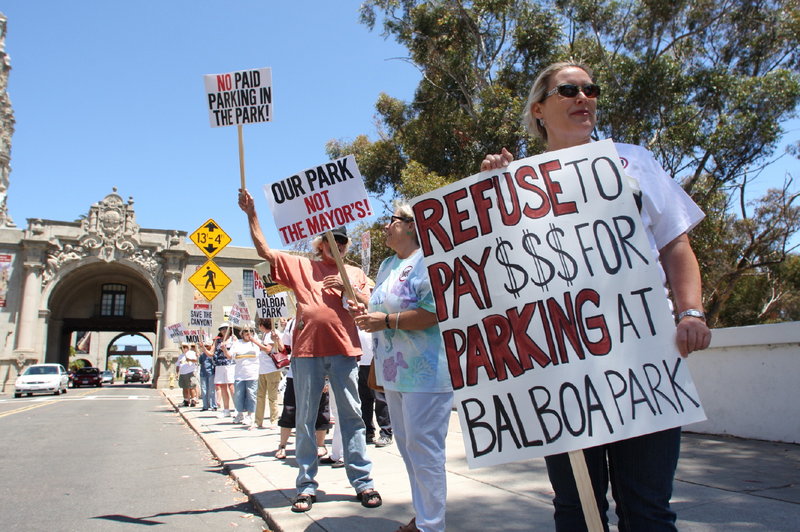
A controversial plan spearheaded by Qualcomm co-founder Irwin Jacobs to eliminate vehicle traffic from the center of Balboa Park and turn it back into a pedestrian plaza in time for the centennial celebration of the 1915 Panama-California Exposition received initial approval by the City Council on July 19. In a 7-1 decision, with District 1 City Councilwoman Sherri Lightner casting the dissenting vote, the council sanctioned a memorandum of understanding (MOU) between the city and the Plaza de Panama Committee, a nonprofit organization chaired by Jacobs that proposes to raise $25 million through private donations to be used toward the design and implementation of the project. “I’m pleased with the outcome,” Jacobs said. “We’re approaching the park’s centennial and the possibility of doing something very special for the people that would open again so many areas of the park got me very excited.” More than 100 speakers signed up to voice their support and opposition to the MOU, which according to Mayor Jerry Sanders is not an approval of the project or binding commitment of any kind, but rather a public statement to Jacobs and his committee that the city council wants to continue down this path. The MOU can be terminated by either party at any time for any reason. As envisioned, the estimated $40 million project, which has been endorsed by Sanders, 26 of the park’s cultural institutions and the zoo, would add a total of 6.3 acres of pedestrian-friendly park space. The plan calls for construction of a 400-foot-long, 40-foot-wide two-way bypass road and bridge to divert traffic through the park. The bypass road would abut the historic Cabrillo Bridge, wind around the Museum of Man and end at a proposed three- level, underground, 785-space parking garage behind the Spreckels Organ Pavilion in the existing Alcazar parking lot. A tram system would be implemented to shuttle visitors from the parking garage to the core of the park and grass would be added to the roof of the structure to increase park space for public use by 2.1 acres. The MOU outlines the committee’s contribution, which includes preparation and funding of an environmental impact report, preparation of all design and construction documents, funding for all construction project management and payment of any construction cost overruns. Sanders said since the project was brought forward to the Balboa Park Committee in September, Jacobs has paid about $2 million from his own pocket. Under the current proposal, the city would issue 30-year, tax-exempt, lease revenue bonds backed by the city’s general fund, which do not require voter approval to pay for the parking structure. The current plan calls for parking revenues to pay the annual debt service on those bonds, which is estimated to be $1.2 million. Any shortfalls in revenue would be covered by the general fund. “Everyone agrees that this project will be supported, that there should be enhancement of the park and there should be improvement of pedestrian traffic circulation. But that is not what this is about,” said Susan Brandt Hawley, attorney for the Save Our Heritage Organisation (SOHO). “This MOU is already picking a preferred project. The Supreme Court has recently ruled that something less than a contractual commitment is a pre-approval that’s illegal under the California Environmental Quality Act.” “The proposed project entails significant and controversial alterations to a major iconic public park, said Joan Dahline, representing the League of Women Voters of San Diego. “If the goal truly is to remove cars from the Plaza de Panama, there are far better, less expensive and less invasive ways to do it.” “Balboa Park has struggled for investment dollars,” said Jessie Knight, chairman and CEO of San Diego Gas & Electric. “We have to get ready for the centennial celebration and some citizens have stepped forward to make a positive contribution to Balboa Park and the long-term interests of San Diego. This is an opportunity to get that process started.” City Councilman Carl DeMaio voiced his approval of moving forward. “It’s a process and this was our opportunity to indicate some concerns, but that doesn’t mean you should let some concerns crowd out what could be a very good outcome,” he said. “I really want to challenge San Diegans to come together like our forefather’s and foremother’s did when they built the park. Let’s come together to make it a truly memorable and visionary place.” Taking it to the courts SOHO filed a lawsuit in Superior Court on Aug. 2 against the city, asking the court to set aside the MOU with the Plaza de Panama Committee — while the state-mandated environmental review process is pending — on the grounds that the agreement violates the California Environmental Quality Act. According to a SOHO statement, it is too early to commit to the “vision” of the Plaza de Panama project as now proposed and that as a practical matter the MOU will have environmental consequences by influencing the shape of future development in Balboa Park. Shortly after receiving a copy of the lawsuit, City Attorney Jan Goldsmith had his staff draft a request to dismiss the case. Goldsmith first asked SOHO to drop its suit or face being penalized for filing a frivolous lawsuit. A hearing in Superior Court on the matter could take 30 days or more.


