


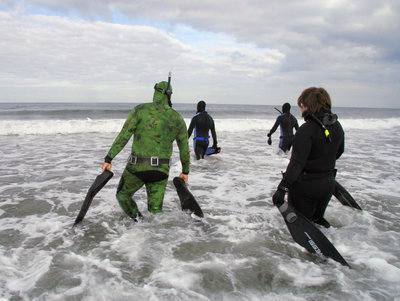
Mark Lozano’s students all have different reasons for wanting to learn how to freedive. Some of them want a new hobby, some want to get some exercise and some want to dive for lobsters. But all understand the importance of safety, because Lozano makes it clear that the only way to pass his course is to know the right way to do the sport. “Freediving can be compared to driving a car,” he said during a recent Level 1 training course at La Jolla Shores. “If you get into a car with absolutely no training, no practice and no license, it’s likely you’re going to get into an accident.” Lozano has been teaching the sport, in which divers hold their breath and take short dives without a tank, through his company, Lozano’s Freediving Instruction, since 2009. He said the majority of instruction in his Level 1, 2 and 3 courses is focused on the safest way to engage in the sport. Popularized by the 1988 Luc Besson movie “The Big Blue,” the sport has often garnered criticism because of fatal accidents involving freedivers. Last October, San Diegan Luke Ausdemore died while freediving for lobster in Mission Bay. Lozano said the only reason for such a tragic accident is not following the No. 1 rule: always be within an arm’s reach of a diving partner. “Like with most things, freediving is 10 percent physical and 90 percent mental,” he said. “You have to know the risks and know how to deal with them. Blackouts and loss of motor control are possible, so it’s important to know how to do things right.” Jeff Griffiths, one of Lozano’s Level 1 students, added, “It’s only dangerous to those who don’t know the dangers.” Lozano said freediving has become more popular recently in conjunction with the green movement, because it is generally regarded as diving “au naturel.” The bubbles created by breathing from a compressed air tank often scare fish, he said, so freedivers sometimes have a greater chance of observing marine life than scuba divers. For some of Lozano’s students, the idea of participating in a sport sometimes considered extreme was the impetus for them to get out of bed early on a Sunday morning and head into the 58-degree water. “I wanted to push myself and see what my capabilities were,” Griffiths said. His classmate, Ryan Gierlych, said the prospect of getting closer to lobsters than he might be able to with a traditional scuba tank was the only incentive required. “Lobster tacos,” he said. “What more motivation do you need?” Lozano’s next freediving course in La Jolla is his Level 2 course, March 19-22. Students are not required to pass the Level 1 course before participating in Level 2. For more information, email Lozano at [email protected]. By the numbers AIDA (Association Internationale pour le Développement de l’Apnée) is an international organization that sanctions freediving events around the world. Here are some of the world records in freediving disciplines as recorded by AIDA: • Deepest dive using only fins or a monofin: 406 feet • Longest distance covered using a fin or monofin: 869 feet • Longest static breath hold: 11 minutes, 35 seconds Freediving instructor Mark Lozano’s statistics: • Deepest dive: 150 feet • Longest static breath hold: 6 minutes • Years freediving: 12


