


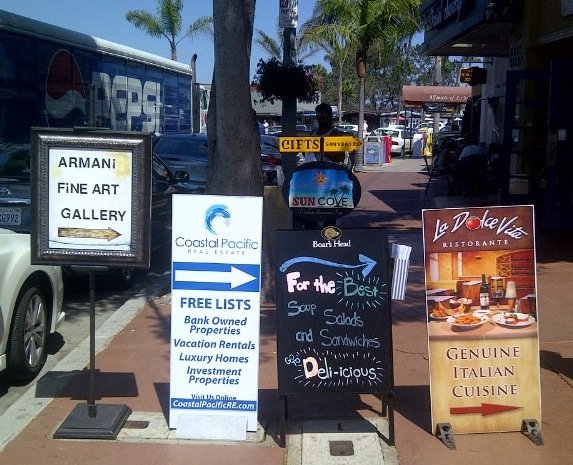
With the aid of the city and code enforcement sweeps, coastal communities like La Jolla are cleaning up their acts, eliminating illegal signage and intrusions into the public right-of-way (PROW).
“We want to make this an educational process, not a shaming of business owners,” said Sheila Fortune, executive director of the La Jolla Village Merchants Association (LJVM), a business improvement district (BID).
Through the public right-of-way enhancement program, merchants with ground-level storefronts in the city’s 12 BIDs are able to use the sidewalks in front of their businesses to place A-frame signs, limited displays of merchandise and outdoor cafés without railings. The PROW program is designed to provide a lively experience for pedestrians and diners and give merchants more leeway to expand their businesses, enhancing profit.
But there are rules to be followed by merchants — guidelines to be met.
“The San Diego Municipal Code prohibits unpermitted encroachments in the public right-of-way including but not limited to: portable A-frame signs, certain types of outdoor display items, umbrellas and other impediments in the PROW,” said Mike Richmond, deputy director of the code enforcement division for the city’s Development Services Department.
Richmond noted BIDs like La Jolla’s have a “certain amount of flexibility” in allowing changes related to PROW enhancement. And the city’s there to make sure PROW program standards are instituted and maintained.
“The code enforcement division of the Development Services Department conducts investigations and enforcement of PROW encroachments on a complaint basis,” said Richmond, adding, “This includes business locations outside of the BID boundaries or locations within BID areas where the BID has not been able to get voluntary compliance through their required notification process.”
Once a code violation is identified by the division investigator, an administrative citation warning is issued that describes the required compliance requirements and time deadline, Richmond said. “If compliance is not achieved by that deadline,” he added, “an administrative citation with a monetary fine is issued. These citations may be appealed by the responsible party, which requires an administrative hearing before an independent administrative hearing officer. A large percentage of cases involving PROW encroachments get resolved by this level of administrative remedy.”
Erin Demorest. from 1st District Councilwoman Sherri Lightner’s office, said that “some businesses on one block in the Village were recently visited by a land development investigator who issued warnings about sign violations. No citations were issued. There has been no ongoing ‘sweep.’ However, neighborhood code regularly receives and investigates complaints about signs illegally posted in the public right-of-way in the Village.”
Fortune said the PROW enforcement program lagged in La Jolla during a recent transition from one BID to another.
“When Promote La Jolla ended their contract with the city as their agent managing the PROW,” she said, “the program did not have local management to carry on this program for several years until LJVMA began the new BID and is now the agent for the PROW.
Fortune talked about what LJVMA and the city are looking for in terms of eliminating illegal signage and visual clutter.
“Signs cannot completely block the public right-of-way,” Fortune said. “Any signs in La Jolla that are freestanding must be on private property.”
Noting it “can get a little tricky” determining where a private property line divides into the PROW, Fortune offered this general guideline.
“Most times,” she said, “a person can tell by looking at the front of the business and following the façade of the building structure and any overhangs of the building. That should be the footprint of the building and private property. The remainder of the sidewalk is the PROW.”
Fortune noted that illegal sandwich boards have proliferated in the Village over the years due to a number of factors, including the downturn in the economy; the city’s labor-force cuts and lack of staff to perform compliance inspections; lack of tourists visiting and patronizing establishments; and the need for locals to shop local.
“This all fueled the need to do whatever (was) necessary for the merchants to attract business… thus, more and more signs were put in the PROW,” said Fortune. She added that LJVMA’s contract with the city gives it the responsibility of managing La Jolla’s PROW.
“This is a huge task and very time consuming considering how large our BID is,” Fortune said. “Trying to educate the merchants is a job that has been ongoing for the last couple of years.”
Fortune noted the city’s Department of Neighborhood Code Compliance has recently hired more inspectors led by Duke Fernandez, senior land development investigator.
“Mr. Fernandez and his staff are working with LJVMA to bring the Village back into compliance and clean up our PROW for all pedestrians to enjoy and safely travel,” Fortune said.


