


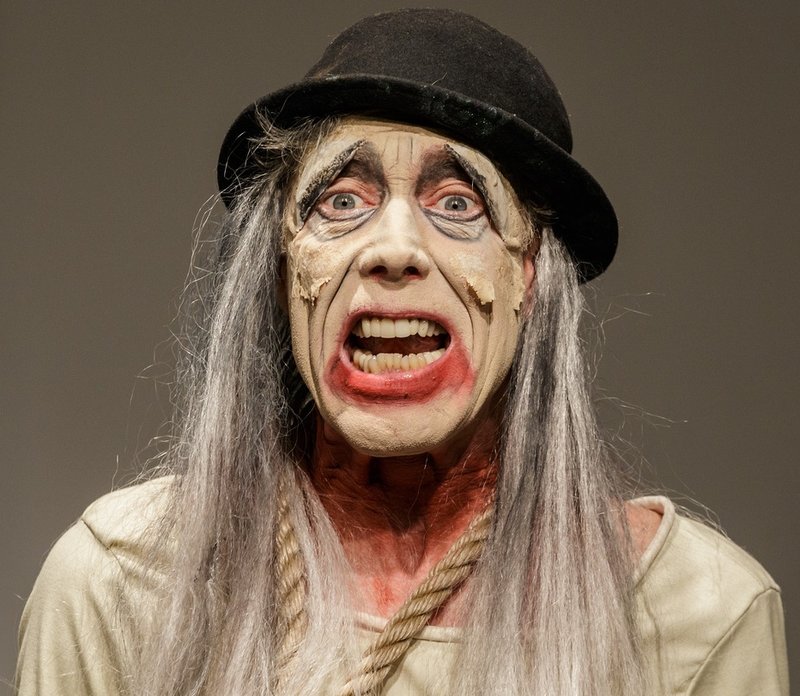
Before his death in 1989, “Waiting for Godot” playwright Samuel Beckett said we have him all wrong in two respects. “Godot,” from the French “godasse” (“boot”), puts the emphasis on the first syllable, not the second (a pair of boots plays a vital role in the script). And know this: In no way is “Godot” a euphemism for God. “If I’d have meant ‘God,'” Beckett once declared in a few choice terms, “I would’ve said ‘God.'” (Beckett, an Ireland native, wrote the play in French; the French word for “God” is “dieu”). But mispronounce and misinterpret we do, even as this monumental work has been performed thousands of times from the U.S. to India since its Paris debut in 1953. Our persistent gaffes are no small things, either. If nothing else happens in this play, the demand for exacting language and phonics certainly does. Out of question, it’s the driving force behind the two central characters’ search for a guy they barely know and probably wouldn’t recognize. fruitlessmoon theatreworks artistic director Aimee Greenberg deftly takes this into account in the current turn at NTC’s White Box Live Arts, serving up a handsome, artful and funny treatise on man’s insignificance in the scheme of things and the absurdity behind the phenomenon of hope. And well she should. Her San Diego-based company is getting its feet generously wet amid her studies with the likes of Stella Adler and Sanford Meisner and a production pedigree from the U.S., Europe and Asia. Vladimir and Estragon, a pair of itinerants who’ve tramped about the universe for the last 50 years that they know of, park themselves at a roadside every day, awaiting the arrival of a man named Godot. He’s supposed to show up today, they surmise, and they camp next to a skeleton of the tree that marks the spot. Like Estragon’s shabby boots, Godot is a euphemism for the remedie du jour, the person or thing or place designed to resurrect purpose amid a lifetime of slings and arrows. Godot, of course, never shows up, fueling Vladimir and Estragon’s pledge to commit suicide by hanging the next day, the culmination of their fruitless search for life’s meaning. “Everything oozes,” Estragon laments — “it’s never the same pus from one second to the next.” For Beckett, life’s only certainty was uncertainty — and beautiful language like that is his declarative tool, culled at once from the nonsensical, the cadenced, the coherent and indeed all three. Greenberg has her cast braying, bellowing and screeching at every opening, their superstylized overwroughtness underscoring the nutty language. Fred Harlow’s Pozzo is a master manipulator, whose cowardice becomes apparent in a pivotal moment of weakness. Lucky is indeed fortunate to have been spared Vladimir’s and Estragon’s weighty questions about existence, and Don Loper plays him accordingly. Jodi Bertran’s Young Boy announces Godot’s nonappearances in the best traditions of an appointed messenger. And Tom Steward’s and Joe Powers’ Vladimir and Estragon are peas in a pod (or not), with Vladimir’s contentiousness the foil to Estragon’s fatigue. Their boot and bowler-swap scenes are priceless (all the players wear bowlers, which is the only stage direction Beckett gives in the script). Meanwhile, Beckett leaves us just enough humor to morph the characters’ ignominious ends into a harmless intellectual exercise. As user-friendly as his play may be, he’s adamant on the importance of the show’s core element —the sound of the words – that gives so much rise to this play’s exhaustive acclaim and to Greenberg’s thoughtfulness in its wake. Very, very good. This review is based on the production of March 26. “Waiting for Godot” runs through April 10 at White Box Live Arts, 2590 Truxtun Road at NTC Liberty Station in Point Loma. $22.00-$27.37. fruitlessmoontheatreworks.org, (949) 246-1698.


