


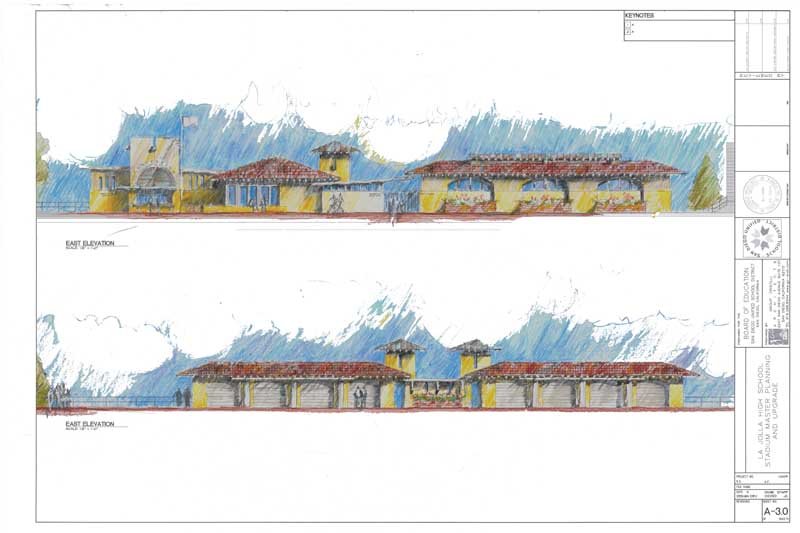
Architect Joseph Cristilli, project manager Alonso Casas and La Jolla High School (LJHS) Principal Dana Shelburne presented a “shovel-ready” plan on April 10 to upgrade the high school’s stadium and modernize other facilities on campus. Although the plans are completed, the project awaits funding from Proposition S, a $2 billion bond measure that was passed in 2008 to fund repair, renovation and revitalization of San Diego school facilities. “The bonds have to be sold,” said Shelburne. “When the market gets right, they sell a bunch and … when the bond’s down they hold off. So, they wait for the cyclical arrival of a good time to sell [the bonds] to maximize income.” The funds raised from the bond measure can only be used on infrastructure projects to improve schools in the district, not on teacher salaries, Shelburne said. “We always get the question, ‘Why are we spending money on this when we are firing teachers?’ It’s because this money is specifically restricted to that use,” he said. “The money is only usable for these kinds of projects. It can’t go to teacher salaries. It can’t go to anything else. It’s got to go to this and nothing but this because that’s what the bond was, and that’s what the people voted on.” Although the entire renovation was originally slated to begin in 2015, the city and project developers hope to accelerate the commencement of the stadium upgrade to late 2013 to ensure the safety of students using the field. “It has reached its years of life in terms of what they call the ‘bounce factor,’” said Cristilli of the field’s artificial turf — the first in the district, which was installed 13 years ago using community funds. Because the field could become a danger to student athletes, the project was divided into two phases of possible construction — upgrade and modernization — with the stadium upgrade set as a priority. If more funds become available earlier than anticipated, however, both projects could commence at the same time. The $5.6 million stadium upgrade will include new turf within the existing configuration, new storage facilities, concession stand, restrooms, chain link fence, plazas, planters with accent lighting, a boys’ locker room, coach’s office, weight room, and nearly $500,000 worth of new handicap accessible ramps. “For the modernization, what we are doing is, architecturally, we are renovating existing restrooms in the building, the cafeteria and general renovation of dilapidated areas,” Cristilli said. The modernization phase will also include new fire alarm and intercom systems, renovation of plumbing and restrooms, landscaping, several new handicap accessible ramps and renovation of the existing cafeteria complete with a food court and dispersed food kiosks in the area. “It’s been a year back and forth on this, but I’m very proud of it. It think it’s a good solution,” said Cristilli. “This is a very complex site. I’ve been doing projects for San Diego Unified for 30 years, and this is my toughest project — toughest principal, toughest project — but the most exciting and, to me, the most fulfilling because this probably completes one of the most beautiful and oldest campuses that we have.”


