


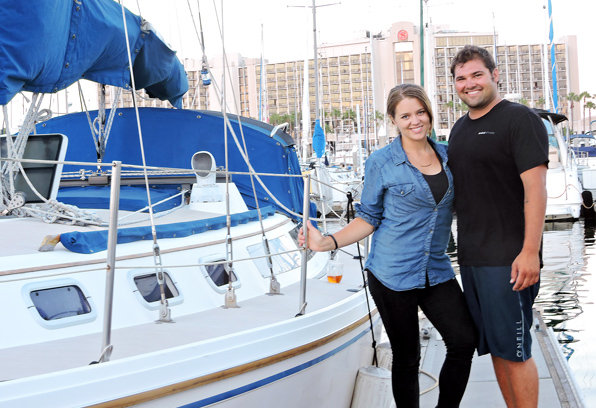
It wasn’t until Bernie Nelson’s 21-year-old sister died of an overdose on April 19, 2008, that he began his search for the perfect boat. He was living at home with his mother when the topic turned to sailing, perhaps as a distraction to offset his shock or maybe to feel something other than the enormous wave of grief that surrounded him. Bernie wanted to think about new adventures. He wanted to live life to the fullest and start while he was young enough to enjoy it. When I mention his sister and the circumstances of her death, Bernie says, “It’s complicated and still under investigation, so I’d rather not talk about the specifics.” Then he extends his left arm to reveal a tat. It’s an outline, a stylized representation of her face; wisps of dark hair, big eyes with long lashes, and her name, Brianne Nicole Nelson, tattooed in bold, black letters. He smiles as he flexes and extends his left forearm. Bernie’s mother helped finance his sailboat with a small insurance settlement Brianne had banked before her unexpected death. Within a year after her death, Bernie became the proud owner of the ‘87 Catalina 34-foot sailing vessel (SV) Independence. When I ask about prior sailing experience, he says, “I’d been on smaller Hobie cats but never a large monohull. Our dad used to take us lake boarding in the Sierras and to Catalina on an 18-foot Sea Ray.” Bernie pauses, looks down for a moment. “I don’t think Brianne ever set foot in a boat larger than the Sea Ray. I think she’d love sailing.” After a few sailing excursions around the harbor, Bernie signed up with the American Sailing Association. “It’s fairly easy to sail, but I wanted to understand the mechanics and concepts involved with sailing. I was planning to fly to Greece with my mom, charter a bareboat in the Greek islands and captain a sailboat to Mykonos, Naxos and Paros. I needed the knowledge, experience and certification for the trip.” Sailing helped ease the pain, but the unexpected death of his sister took Bernie by surprise. It isn’t easy to experience a loved one’s death at any age, but at 26, loss takes a toll. After Brianne’s death, Bernie worked as an intern at an architectural firm before starting a five-year program at the New School of Architectural Design in downtown San Diego, where he met fellow student, Melissa Vaughn, who shared his passion for adventure and the sea. They dated for a year before renting a house in Ocean Beach, using the Independence for staycations. In 2012, they decided to downsize, sell most of their belongings and live full-time on the Independence, docked at Cabrillo Isle Marina in Harbor Island – a decision they haven’t regretted. When they talk about downscaling from a house to a boat, approximately 260 square feet, Melissa says, “He’s very simple. It was harder for me. We had a huge garage sale and sold the majority of our belongings.”
I ask about challenges as liveaboards, and they giggle as if there’s a joke only they are privy to. “Fighting. You don’t get your own space,” Melissa says. “One of us usually retreats to the hammock, which hangs from the mast to the forestay. It’s a good solution.”
On Friday nights, music blasts from the Independence. By Saturday and Sunday morning, empty beer cans are scattered on deck and the surrounding dock. “We work hard on weekdays and play hard on weekends,” Bernie says with a boyish grin. His face has a ruddy look. He has big brown eyes and dark, wavy hair that glistens in the sun. He’s softspoken, with a hardy laugh. There’s a sadness noted that isn’t outwardly displayed, a kind of inner grief that exposes itself from time to time, as if a bandage has loosened revealing an unhealed wound. Melissa, a brunette with brown eyes and a mellow disposition, can be spotted every few months cutting Bernie’s hair on the dock. He sits straight on his chair drinking a beer, staring out at the water, bare-chested, wearing sunglasses and a pair of shorts. After a few snips, Melissa bends over to kiss him. Their dog, Kaya, a Chiweenie they bought at a dive bar in Point Loma, stands watch on the deck alerting them to seagulls, small children and other dogs that pass by. Bernie describes the inside of their boat. “We have a u-shape settee to starboard,” he says, “and a straight settee on portside. There’s only one comfortable spot, and it belongs to whoever gets there first.” “Or he just gets it,” Melissa adds, smiling. I ask them what happens when one or the other wants to read and one wants to watch TV. “I’ll just take my book into the aft cabin, “Melissa says. “We don’t read a lot, and our basic Internet service is spotty, so it’s hard. We’re cutting back on everything, trying to get away from the monthly payments.” Bernie laughs. “We don’t have to worry about phone service,” he says. “I was drunk on the dinghy when I lost mine, and Melissa ruined her phone when she dropped it in a washing machine. All our social communication is done via Facebook.” “We live in a tiny space and work in cubicles at our office. That gets difficult,” says Melissa. “We look forward to weekends when we can party and sail.” Recent trips include motoring to a concert at Humphrey’s on their dinghy and cruising to Coronado Island and Mariner’s Cove in Mission Bay. “Last weekend, we went to La Playa, dropped anchor and tied up with a friend and paddled around in our dinghy.” says Bernie. “There’s something about sailing that sets you free – cruising out the marina with nothing around you but ocean.” We began talking about social situations for liveaboards. “When we moved into our sailboat, I had no idea what to expect,” says Melissa. “The best thing about living at Cabrillo Isle Marina is the being part of this tight community.” Bernie compared it to a “glorified trailer park. “You get to hang out with millionaires, engineers, architects, writers – people from all walks of life.” A subject Bernie is adamant about involves marinas setting a limit on the number of liveaboards. Cabrillo allows 10 percent liveaboards, and currently they are at 8 percent.
“Marinas think of liveaboards as second-class citizens, afraid of attracting derelict boats,” Bernie says. “But at the same time, it’s like a neighborhood watch – eyes on the marina, the boats, and a safer environment for everyone who docks here.” The topic turns to marina management. “I wish they would provide more security, like they used to,” Bernie says. “I had a surfboard and bicycle stolen, one from storage and another from my car. But we feel safe on the boat.” Bernie and Melissa sit on the settee, holding hands, talking about a certain liveaboard mindset. “When someone walks by, you say hello. It doesn’t matter who it is,” Melissa says. “You end up bringing that type of warmth to other areas of your life.” They grin when they talk about the perks of living aboard – marina parties, discounted food, Jacuzzi and swimming privileges at the Sheraton and a 20 percent discount off all food and soft drinks at Tom Ham’s down the road. The subject returns to Bernie’s sister, Brianne. “How do you handle the anniversary of her death?” I ask. Bernie ponders the question for a few seconds and says, “I drink a Jack and Coke because it was her favorite drink. Otherwise, I drink my usual – rum, vodka or beer.” From outside the hatch, we hear “Ber-Nie” shouted from across the way. “Ber-Nie, come on over!” “That’s Chris on D dock,” Bernie says, laughing and blushing. Again, we hear, “Ber-Nie, you there?” I stick my head out the hatch and yell, “Bernie’s busy; he can’t come out and play.” As the sun sets and prevailing winds whistle through the halyards, I ask about plans for their future. “We think spending our money on traveling and seeing the world is more important than marriage,” Bernie says. “Our goal is to save up money, quit our jobs and sail to Mexico and who knows where else. We’re only young once.” “I know one thing for sure,” Melissa adds. “I definitely don’t ever want to live back on land.”


