


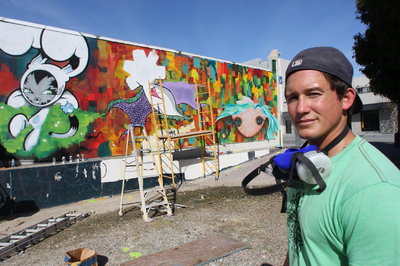
Navigating the streets and freeways of San Diego, one is bombarded by images. Signs, letters and symbols greet us everywhere we turn, most of them uninvited. Giant billboards tell us to do things, buy things, be things. With all of this unsolicited imagery, somehow it comes as a surprise when we encounter an illustration with no sales pitch. Take East Village’s newest mural, an illustration with only one motive: to entertain. Placed smack on the corner of Park Boulevard and G Street facing an empty lot, the mural popped up one weekend in March, a burst of color on a block otherwise dominated by shades of gray. “Our goal was to share with the community a positive message through visual representation,” said Monstrinho, one of the artists, who prefers to go by his street art name. “We wanted it to be a positive landmark for the city. The most important thing is for people to get a positive feeling when they drive by.” Monstrinho (or “little monster” in Brazilian Portuguese) and his fellow artists, Gloria Muriel and Persue (pronounced per-SWAY, also the artist’s street name), were commissioned to do the mural by Arturo Gonzalez, co-owner of the new hART Lounge, a café/art supplies store/hookah lounge slated to open in May across the street from the New School of Architecture. Gonzalez had seen Muriel’s work when both were working at BioNine Designs, a website design company. When Gonzalez bought the building on Park Boulevard, he approached Muriel about the vacant wall. “The mural should draw people’s attention to art. It should bring some happiness to that area,” Muriel said. “It’s something that, hopefully, people will pass by and it will completely change their mood.” Muriel, Monstrinho and Persue have visibly different techniques. One wonders how something as cohesive as a giant mural could come together from three such different perspectives. Muriel said the team put together some sketches, discussing themes and visuals. In the end, however, each naturally tended toward his or her own style and the mural developed organically. Persue, well known in the world of street art, painted “BunnyKitty,” his trademark character. Monstrinho chose “Angelface,” also a character that often makes appearances in his work. Muriel, with her background in fine art, painted the ethereal, doe-eyed girl that she has come to call “Glow.” Before the mural was even finished, the artists’ goal of changing the mood in the neighborhood seemed to be working. Monstrinho, who describes Angelface as “sort of a mother character, overlooking everybody, keeping everyone happy,” discovered that the positive imagery was already infusing itself into the community, even before the final touches had been made. “We had wealthy people, poor people, students, all walking by us and thanking us while we were painting,” he said. “A lot of people honked their horns and told us how much the community needs positive images. We have to see billboards whether we want to or not, so it’s nice to have things like this that are more positive.” Monstrinho lamented the fact that San Diego, while brimming with talented artists, doesn’t get the same reputation for being an artist’s haven as does somewhere like New York City. “There’s a general consensus that everyone has to go to L.A., New York or San Francisco to be creative,” he said. “But there’s a tremendous amount of talent here that doesn’t get the chance to shine. San Diego has enough talent to represent itself along with those other big cities and have its own creativity pool.” Persue had similar reasons for adding his signature to the mural. “I felt that downtown is lacking when it comes to art and murals from local talent, so I jumped at the opportunity,” he said. Gonzalez also wanted to give a boost to homegrown talent. He and his business partner, Harsh Bohra, intend to hold regular art shows featuring local, up-and-coming artists and art students. The businessman in Gonzalez is happy that his first investment is succeeding so far, but the artist in him wants that part of the venture to remain in the background. He would prefer it if people didn’t really know — or question — the story behind the mural, but that they just enjoy it. “This is just the venue,” he said. “I want the art to be central, not the business. It’s a space where art can just be.” For the artists, that kind of venue is the beginning of what they hope will become the norm. Monstrinho described a San Diego where murals and public art are a rule, rather than an exception. “The bigger guy in our country will always win,” he said. “Street art is the individual’s way of claiming back public space.” Muriel agreed, adding that she believes creativity will naturally be engendered once people start to see art on San Diego’s streets all the time, all around. “Street art is so powerful, it can send all kinds of messages,” she said. “Our purpose was to start changing this neighborhood and every neighborhood, one by one, wall by wall.”


