


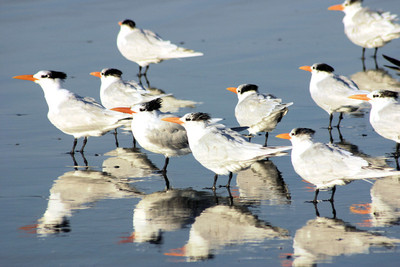
On Dec. 15, San Diego participated in the 108th annual Audubon Christmas Bird Count, the longest running wildlife census in the world.
The Audubon Christmas Bird Count will continue throughout the nation until Jan. 5. Data collected from the census will not only track the endangered species and their habitats but also assist in fueling global warming research.
“You can’t underestimate the value of having people go out and count the number of birds they see,” said Garrison Frost, director of marketing and communications for Audubon California. “When you find a major environmental impact going on, you’ll often see it in the birds first.
“If something is affecting the movement of birds, you’ll probably see an impact on other wildlife species as well. Birds just have the ability to get up and move quicker than other species.”
Since 1900, volunteer groups across the nation have dedicated the holiday season to the Christmas Bird Count.
The count began as a response by conservationists to a holiday hunting tradition called a side hunt, according to Frost. Hunters would choose sides and have a bird-shooting competition. Conservationists counteracted the hunters’ activities by counting as many birds as possible.
Each count consists of a group of volunteers and at least one experienced bird expert. A number of groups are assigned to count birds within an established 15-mile-diameter circle.
In San Diego, the center of the circle is at the mouth of the Sweetwater River. The circle goes west to Point Loma, north to Balboa Park, east to the Sweetwater Reservoir and south to the Tijuana River Valley, according to Philip Unitt, curator of the department of birds and mammals at the San Diego Natural History Museum.
San Diego has maintained the same circle since the early 1960s. Thirty-two groups and 100 volunteers headed the count this year and found 213 species of birds, the fourth-highest number recorded in San Diego, according to Unitt.
“There was quite a number of rare birds known ahead of time, and people went to look for those on the morning of the count, and almost all of those were seen,” Unitt explained.
Although data from the nationwide count will not be published almost a year after the event, results thus far will be available soon at www.audubon.org/bird/cbc.


