


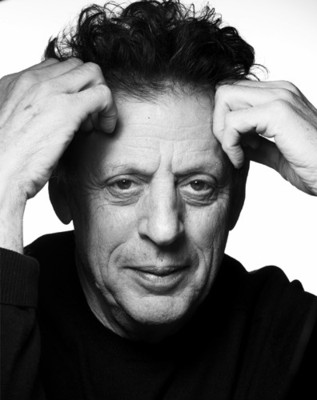
The day following La Jolla Symphony’s Nov. 3 performance at Mandeville Auditorium, the critic’s mind is filled with possible descriptive metaphors. The concert featured the American premiere of Philip Glass’ Cello Concerto, which juxtaposed John Luther Adams’ “The Light That Fills the World.” At the same time, her cyberspace inbox is rife with an exchange between two male poets on opposite sides of the world going at it over one’s new work about the fires in San Diego.
Like a poem, music on the level of Glass and Adams is what it is. One might quibble over word usage and technique, but each, in its own right, is a kind of poetic statement in sound.
When an artist reaches a certain maturity, he/she becomes be his/her own critic. Glass says that he’s made changes in the score since the work was premiered by Lloyd Webber. What the audience heard Saturday night at Mandeville was immensely pleasing to Glass, who gave the American premiere to cellist Wendy Sutter, who in turn chose to play it with La Jolla Symphony under the baton of Steven Schick. Schick, who just became music director, is the right man at the right time, both for La Jolla Symphony & Chorus and for Glass. The 70-year-old composer described the La Jolla performance, his first hearing of the work, as a gift and a relaunching of the piece that is a part of what’s called Glass’ Concerto Project.
The China Philharmonic premiered the Cello Concerto in Beijing, Oct. 21, 2001. It was just after 9/11 and no one was flying. Subsequent performances also proved impossible for the composer to attend. He’s heard Lloyd Webber’s recording, of which he doesn’t seem too fond, and even insists there will be another recording. Upon hearing the work live in La Jolla rehearsals, he said, “My, God, we got it right.”
The concerto begins with cello solo over double basses. Most people think of Glass as a minimalist composer, when in truth, as he told listeners at a pre-performance lecture, no one’s been writing minimalist music for 30 years. “Minimalism is the subtext of the music,” he said; and as subtext, repeated arpeggios accompany ravishing melodies in the cello, so beautifully and ably played by the New York-based Sutter.
There could be no better conductor for the work, which is melodic, joyous and passionate by turns. The third movement is quite swinging and rhythmic with a finale that graciously dwindles, leaving the cello to make the final statement. Though it sounds like movie music in places, this is a surprisingly likable work, and one sees it becoming part of the standard repertoire since there are so few cello concertos. The performance elicited a standing ovation and huzzahs for Glass, Sutter, Schick and the orchestra that worked diligently and well.
Adams lives in Alaska and specializes in music that is “an aurora borealis painted with sound,” as aptly put to Schick by board president Amee Wood. At first one waits for something to happen in this wall of sound, where everyone bows independently; and then, ever so gradually, there are progressions that seem utterly inevitable. The music is otherworldly, a bit like seeing the Grand Canyon for the first time. Audiences hear more of Adams and from Adams when his “Dark Waves” is performed on a May 4-5 program titled “Where I’m calling from.”
To close the program, Schick conducted a brisk performance of Ludwig van Beethoven’s Fourth Symphony. Expect much from this sensitive and charismatic conductor and his fine, recently acquired community orchestra, now in its 53rd season.


