


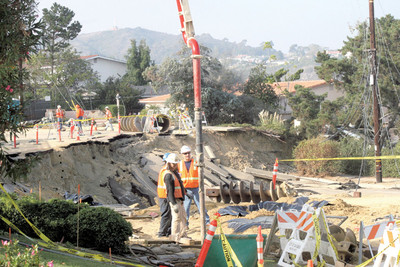
As the City of San Diego continues the first phase of repairs from the Oct. 3 landslide on Mount Soledad, more homeowners have added themselves to the litigation list ” including residents at the other side of Soledad as they prepare to undergo major testing of their street early next week.
At least 15 homeowners, including two whose homes were destroyed in the landslide that occurred a month ago on Soledad Mountain Road at Desert View Drive, have retained counsel.
Although the city continues to investigate the cause of the landslide, experts representing the homeowners have initiated a new testing program.
“We’ve requested to do a deep boring in the middle of where the slide occurred,” said Patrick Catalano, an attorney representing at least 15 homeowners at or near the Mount Soledad landslide. “We think the slide is due to leaky water and fire hydrants.”
Experts with American Geotechnical Inc., a company working for the homeowners, said that if there is any water to find it will be in the middle of the slide plane.
Because the city is conducting its own investigation while the homeowners have decided to litigate, Catalano said the city’s probe into the cause of the landslide splits into part investigation and part litigation.
“What causes a landslide is water saturating a hillside,” Catalano said. “We have evidence that one fire hydrant was leaking for five days … There’s a lot of potential money damages, and I’ve never had a city in the world come out and say that, yes, they were wrong.”
The first phase of construction involves drilling holes and installing shear pins into the side of the landslide. According to Mayor Jerry Sanders’ office, experts began repairing the slide on Halloween and should be completed with the first phase by the end of November or early December.
“We’re looking at a total of 37 shear pins, and we’ve installed seven to date,” said Carol Drummond, public information and media relations official with the City of San Diego.
But both the mayor’s office and representatives of the homeowners said they have been seeking alternative engineering options now being evaluated, including different ways to stabilize the landslide. And talks between the city and the homeowners are already under way about what areas to fix and who should be held accountable for the cost.
“Certain proposals are to put in some tie-backs, and they’re under consideration from our experts,” Catalano said.
Tie-backs prevent the slide mass from moving further. They are a preventive avenue that the area does not yet have, and may need if heavy rains occur, he said.
But with the cost to fix the area rising into the millions of dollars, the city came out and said it was going to deny the homeowners’ claims, Catalano said.
Right now, Catalano said he represents two homes destroyed in the slide. Along with the homes’ appraised value, the value of the lost contents inside the homes will be added to the claims. Four homes are not completely destroyed but “suffered impacts like cracking,” he said.
The rest of the homeowners Catalano represents are near the slide but “will never be able to sell it [their homes], because who’s going to buy it?” he said.
While homeowners on Soledad Mountain Road experienced loss of property and property value and continue litigation with the city, some residents at the other side of Soledad, on Via Avola, are preparing to undergo major construction and testing beginning next week to see if their future will be similar to their neighbors.
Although Catalano said he spoke with the residents of Via Avola, he has not met with them or taken them on as clients at this point. The difference between Avola and the Soledad Mountain Road landslide, from a legal point of view, is that the residents of Avola are located on a private road. While the city has an easement for their utilities to run through the road, the residents must pay for any damages through their homeowners association.
“The city owns and maintains the water lines but doesn’t maintain the streets,” said Steve Borron, project geologist with American Geotechnical Inc. “That’s the responsibility of the homeowners. If a storm drain breaks or is leaking, the city will just patch it.”
American Geotechnical, the company representing the homeowners on Soledad Mountain Road and acting as an expert witness, has worked on many major landslides. Via Avola has shown visible signs of moving, and, beginning Monday, after applying for many permits, Borron and his team will be able to drill holes on the road and install inclinometers to gauge any immediate threat.
“We will take multiple readings to determine the rate at which the land is moving,” Borron said. “We’re starting the drilling program next week and we’re eventually going to videotape storm drains and the sewer lines.”
Because the entire mountain is located on an ancient landslide area, and because the homes were built before technology allowed for appropriate building codes, Borron said he is skeptical about the outcome but is hoping for the best for the Avola homeowners But even if the company can prevent a slide before a seismic event, or before a heavy rain, the city will be reluctant to pay, and insurance will not pay unless an event has already occurred, he said.
“It’s in a bad area, but I’m hopeful for the homeowners because nothing’s failed yet ” that it is just some of the fill from the original grading of the site,” Boron said. “If it’s deeper, that would be a significantly bigger problem, but the HOA is going to have to pay whether it’s fill or deep-seated.”


