


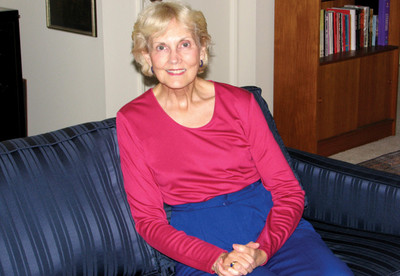
Best-selling author and University City resident Susan Vreeland is known for crafting art-oriented novels using lyrically evocative prose and for drawing characters so vivid they seem to bound off the page.
“Luncheon of the Boating Party,” her sixth book and fourth art-focused novel, tells the story surrounding Pierre-Auguste Renoir’s creation of his Impressionist masterpiece of the same name, now in the Phillips Collection in Washington, D.C. The book was published in May and quickly found a spot on The New York Times’ best-seller list.
On Saturday, Oct. 13, at 2 p.m. at the Lawrence Family Jewish Community Center, 4126 Executive Drive, Vreeland will deliver a public lecture titled “Ekphrasic Literature: A Piece of Art,” in which she will discuss her methodology in writing fiction based on art and historic characters. The lecture is sponsored by the Alliance Française de San Diego and is free for members, with a suggested donation of $10 for non-members or $5 for students.
“Ekphrasis is the use of one art form to describe something created in another form,” explained Vreeland, 61, who taught English literature at University City High School for 18 years before retiring from the San Diego Public Schools in 2000.
She will use examples from both “Luncheon” and an earlier collection of short stories, “Life Studies,” to explain the concept of ekphrasic literature.
Her lecture, which will include photographs of art and significant locations from her book as well as music of the period, will focus primarily on “Luncheon,” its genesis, research, characters, setting and social context, she said.
While “Luncheon” might seem initially just a well-written and absorbing entertainment, it quickly reveals meticulously researched material imaginatively shaped by an author with respect for historical accuracy.
Readers may experience the novel on different levels. While illuminating Renoir’s life and his creative process in parallel with the lives of the 14 friends who modeled for his masterwork, Vreeland’s portrait of “la vie moderne” also offers insight into the explosive artistic and intellectual creativity and changing social climate and art scene of 1880s Paris following the destructive Franco-Prussian War.
Imbued with a love of European art following a visit to Paris and the Louvre in 1971, Vreeland fell in love with Renoir’s “Luncheon of the Boating Party” during a visit to the Phillips Collection. She spent three years researching and writing her novel, doing most of her research at the San Diego Public Library and UCSD Library.
She did not plan to become a writer, but studied English literature and library science at San Diego State University before embarking on a 30-year teaching career. She began writing features for newspapers and magazines in 1980, publishing about 250 articles relating to art and travel. From there, she wrote short fiction for literary journals and in 1988 published her first book, “What Love Sees,” a fictionalized biography of a friend’s parents, who were determined to experience a full life despite blindness.
She discovered her talent for writing about art and painters by chance.
“I was writing short stories,” Vreeland said. “A fellow writer said that ‘your writing is most vivid when you’re writing about a painting.'”
That comment encouraged her to begin work on stories which became “Girl in Hyacinth Blue,” dealing with a fictional 36th work by the 17th-century Dutch painter Vermeer and tracing its influences on its owners into the 20th century.
In 1996, just as her first book was turned into a CBS television movie, she was diagnosed with lymphoma. Through lengthy chemotherapy treatments and a subsequent bone marrow transplant, she found “a healing tranquility” by focusing on art, creativity and writing.
“Creative endeavor can aid healing because it lifts us out of self-absorption and gives us a goal. Mine was to live long enough to finish this set of stories that reflected my sensibilities, so that my writing group of 12 dear friends might be given these and know that in my last months I was happy ” because I was creating,” Vreeland wrote in a biographical essay posted on her website.
She has no doubt her illness affected her writing, saying it enhanced her compassion for her characters and enabled her to write with a new level of sensitivity.
Vreeland is clear about why she writes fiction and why she writes about art.
“Art feeds the imagination so that through a painting we can enter into the life of another person,” she explained. “Imagining others’ lives gives us a human connection which stimulates compassion. Without compassion there’s no human understanding, no loving kindness, and people become isolated and self-oriented. The isolated can turn cruel and the tragic hovers in the form of violence, holocaust and terrorism. Art and literature are antidotes to that.”
For more information about Vreeland’s lecture, visit the Alliance Française website, www.afsandiego.org, or call (858) 824-6694.


