


Speed sometimes can be relative.
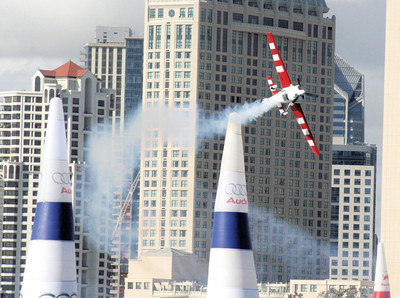
A case in point would be Paul Bonhomme’s victory in the Sept. 21-22 Red Bull air races on San Diego Bay before an estimated 50,000 spectators.
At 221 mph, the British flyer was one of the slowest of 13 pilots entering the starting “box” en route to three penalty-free aerobatic combats, slicing a three-pylon chicane and engaging four goal post like pylon “gates.” Others chose entry starts at least 20 mph faster.
“You can’t go real slow,” said Bonhomme, who won for the third time in the nine races this year. “But it’s more important to develop a line and strategy to get through the gates.”
Not even being down a cylinder with a bad spark plug in the semifinal match against countryman and aerobatic teammate Steve Jones could stop Great Britain’s top aerobatic pilot.
After his quarter- and semifinal triumphs, he then narrowly defeated last year’s champion, Texan Kirby Chambliss. Bonhomme’s time for the 1.1-mile slalom course was one minute, 23.80 seconds to Chambliss’ 1:24.69.
Although there had been storm warnings, the races were played out in blue skies with puffy white clouds. Still, the pilots had to handle 17 mph winds.
Crowds gathered along the shores of the Embarcadero on one side and Coronado across the bay. The breathtaking waterfront skyline set the backdrop for a picture-perfect addition to San Diego’s aviation history. Additional viewers were entertained from nearby hotel and condo high-rises.
What makes the air race so exciting and interesting for spectators is the proximity of the contest to the fans. Low-level flying on a compact course means people can experience all the action close-up.
Two capable English announcers kept a steady, informative banter to appraise fans of speed as well as seconds gained or lost and reasons for penalties in the learning curve of a new sport. Tower reports to participants also could be heard.
A smattering of applause came when qualifying times were announced the first day but cheers were heard on the head-to-head duels the next day.
Billboard-size television screens provided people with action and close-ups of the participants.
A loud horn signified penalties. These occurred if pilots hit pylons, too high or low gate approaches and improper angle.
“Smoke On!” came the official command as each plane started its run. These snarling little carbon fiber planes, spewing a trail of smoke, are 1,100-pound power packages with 300 horses.
If anyone encountered engine trouble or caught part of a nylon pylon with a wing, North Island air base offered an open runway.
Flyers were given a six-minute alert to take off from Brown Field, near the Mexican border, to reach the course. If a pylon needed a repair, they had enough fuel to hover. Pylons are made in zippered layers and usually can be inflated in five minutes.
Flyers were notified of their time as soon as the run was completed but didn’t get the result of an opponent until the six-minute return trip to Brown Field.
The victory on his 43rd birthday catapulted Bonhomme past Mike Mangold of Victorville, Calif., into first place for the championship and set up a showdown in Perth, Australia, this November. Mangold, who encountered penalty problems on opening day, was eliminated in the quarterfinals.
They tore down, packed all the planes and additional gear in a 747 and have taken the flying circus to the land down under for the 10th and final stop of the whirlwind tour to be held on Nov. 3 in Australia.


