


Don’t mess with “Carmen,” that is unless you’re stage director Peter Brook or film director Carlos Saura. Or even Cirque du Soleil director Franco Dragone.
In 1981 Paris, slightly more than a century after the 1875 premiere (at Opera Comique) of George Bizet’s now incredibly popular opera, Peter Brook staged “La Tragedie de Carmen,” his own pared-down version of the four-act opera.
The opera libretto is based on Prosper Merimee’s novella. When Brook’s piece premiered in New York two years later, The New York Times (Nov. 20, 1983) wrote, ¦what results is simply a self-indulgent auteur’s meditation on the opera’s theme.”
With original music by Paco de Lucia and some of Bizet’s original score, Saura’s 1983 flamenco dance film fared better with the critics and is hailed as a classic.
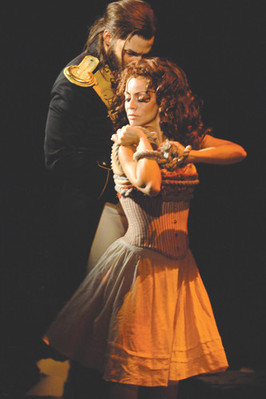
Oh, that the current musical on display at La Jolla Playhouse were that of a self-indulgent auteur. One hoped for something like that from director Dragone, known mainly for 15 years of creating shows for Canada’s Cirque du Soleil. His “Carmen,” in its world premiere production at La Jolla Playhouse, has marvelous physicality, stunning choreography by Sarah Miles, who also wrote the new musical’s book, and drop-dead gorgeous visual imagery by scenic designer Klara Zieglerova and lighting designer Christopher Akerlind; however, any true originality of vision is quashed by John Ewbank’s musical score and AnneMarie Milzazzo’s lyrics.
The dance and non-singing scenes are best. The gypsy dances and especially the women’s flamenco challenge duel in the cigar factory stand out. As Carmen and Jose, Janien Valentine and Ryan Silverman are well matched. The diminutive Valentine possesses fire and is an excellent dancer. Though his high register has an unpleasant edge and he tends to sing above pitch in the stratosphere, Silverman is robust, tall and handsome. When Don Jose rope-tows the unwilling and willful gypsy through the countryside, the building sexual tension, underscored by a habanera, is quite convincing.
As the pitiful Micaela, the wife Jose left in Basque country, Shelley Thomas has as tough a job as her operatic counterpart, and she’s married. Micaela is tailed throughout by three women in black, redolent of Federico Garcia Lorca’s widows. Perhaps she’s a bit less bland than her operatic incarnation, but Bizet had the good sense to give her much less to do. Here she gets two duets and two songs. Miles, the musical’s book writer, insists on going home again and again, each time killing the dramatic tension building in Seville.
To her credit, Miles makes more than stereotypes of Carmen’s gypsy friends Mercedes and Frasquita, and Carmen’s stabbing victim, Juanita (the excellent Shannon Lewis), is an interesting character. Miles also resurrects Carmen’s husband, Garcia (Marcos Santana), from the novella, and Jose’s superior officer, Zuniga (baritone Neal Benan) has his own aria. These are interesting developments, but one questions Miles’ choice to make Jose an established ruffian: In the first scene, he must choose between prison and serving in the military. So much for the country bumpkin innocence that leads to his tragic obsession.
One more thing: the bullfighter Escamillo must sing more robustly and be more dashing and virile than Jose. In the show’s longest wig, Victor Wallace more resembles Johnny Depp playing pirate.
One longs in this case for a musical without music ” just the dance and the drama and Dragone’s vision. Those were the good parts. The rest was mostly just loud.
“Carmen” continues in its world premiere nightly except Monday, through July 22 at the Mandell Weiss Theatre, La Jolla Playhouse, 2910 La Jolla Village Drive.
For tickets ($40 to $100), visit www.lajollaplayhouse.org or call (858) 550-1010.


