


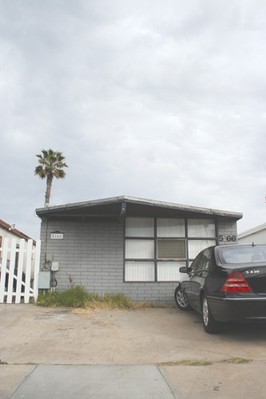
Despite a community effort to halt the project, the San Diego Planning Commission unanimously approved permits Thursday, March 1, for a controversial home expansion on West Point Loma Boulevard.
David Stebbins, owner and resident of the property at 5166 West Point Loma Blvd., has proposed the demolition of the one-story duplex to construct a three-story, single-family residence. The plans also call for an 816-square-foot underground basement garage accessible from the street.
Stebbins’ home is currently one of 18 similarly designed duplexes near Dog Beach, all one story tall.
While neighbors in opposition to the project are concerned that a taller, larger home would obstruct the ocean views of nearby units, it is the proposed garage that requires a special permit from the city. In fact, Stebbins’ plans fall within the municipal code’s requirements on height and set-backs, which determine the bulk and scale of development.
However, the plans do not comply with coastal rules regarding construction on a flood plain. The Federal Emergency Management Agency (FEMA) requires that homes in special flood hazard areas, such as Stebbins’ near Dog Beach, be built at least two feet above the base flood elevation.
The proposed garage would instead be located 7.1 feet below that level.
Stebbins’ proposal first went before the Planning Commission Feb. 8, at which time the group was unsure if FEMA regulations allowed for underground parking in flood hazard areas. Stebbins was asked to return March 1 for a decision.
The recommendation of the Ocean Beach Planning Board was split down the middle, casting two 4-4 votes since July 2006.
At the more recent meeting, which Stebbins and more city engineers attended, it was determined that municipal code does allow for certain construction of below-grade parking with approval even though FEMA does not.
In Stebbins’ case, a proposed water- and flood-proofing system complete with pumps was deemed sufficient to mitigate any flood risk.
“These systems are regularly used in areas of the country that experience floods far greater than anything we’ve talked about the potential for being here,” Stebbins said. “In the flood zone where I’m at, the potential for flooding comes from the overwhelming of the storm drains.”
Only one of the three Ocean Beach residents who spoke at the hearing addressed the issue of the basement garage and potential flooding.
Landry Watson, a homeowner on West Point Loma Boulevard, raised concerns that the Ocean Beach Planning Board was not aware of the FEMA regulations when they voted on the matter.
No one from the board was present at the hearing.
Ocean Beach Planning Board member Mike Taylor said Wednesday, March 5, that rules and regulations were pointed out at the meeting, but that he did not recall specifically whether FEMA regulations were discussed.
Watson, along with other residents, also alleged that the bulk and scale of the project would obscure the oceanic scenery and set a precedent for similar construction among the neighboring duplexes.
However, commissioners pointed out that the Ocean Beach Precise Plan does not restrict development near Dog Beach to one story. And since Stebbins’ plan complies with the state- and city-mandated 30-foot coastal height limit, he is well within his rights, they argued.
“[The project] does all the things that the Precise Plan talks about,” commissioner Eric Naslund said.
While he said he appreciated the opinions and reasons residents gave for opposing the project, Naslund noted that the real issue revolves around the more than 30-year-old Precise Plan. Naslund said the plan should reflect residents’ desired bulk, scale, size, height and FAR (Floor Area Ratio) for their neighborhoods, so that “there isn’t a debate “¦ where someone [who] has obeyed all the rules and done all the right things “¦ gets sort of punished.”
The Precise Plan, created in the 1970s, is being updated. Naslund directed residents to contact Tony Kempton at [email protected] to get involved in that process.
But Watson said it’s not so easy to translate a community’s vision into detailed code.
“I can’t tell you how frustrating it is to try to update something that is 200 pages long and over 30 years old,” Watson said in an e-mail. “Perhaps the community plans themselves need to be struck and started over “” something more flexible that can be more readily updated with the changing of the times.”
The larger resident concern that emerged from the hearing was one of precedents. Watson said he feared a developer could purchase and build up the block of duplexes, gentrifying the area.
“If this proposal stands, this entire block could very well be massive vacation rentals before it even gets hot this summer,” Watson said. “What grounds would the planning commission have to say no to a developer now that they have already said yes to the issue?”
But Naslund answered that the project at hand is proposed by a homeowner who actually lives at the site, making gentrification a nonissue.
“You (Stebbins) are presently part of the community and you are improving the property that you have lived on and will continue to live on,” Naslund said. While Watson said he believes that Stebbins has a hidden agenda, Stebbins assured the commissioners at the hearing that he did intend to live on the property after its redevelopment.
Should the residents appeal the commission’s March 1 vote, Stebbins will have to defend his plans before the City Council. An appeal must be filed to the City Clerk by Thursday, March 15.
Appeals must be based on grounds of a factual error; new information; unsupported findings; conflicts with the land use plan, City Council policy or municipal code; or citywide significance.
Watson and other community residents attended the Wednesday, March 7 Ocean Beach Planning Board meeting in hopes that the board would file a joint appeal to the City Council. Results of this meeting were not available as of press time.
Once an appeal is filed, hearings are scheduled within 30 days.


