


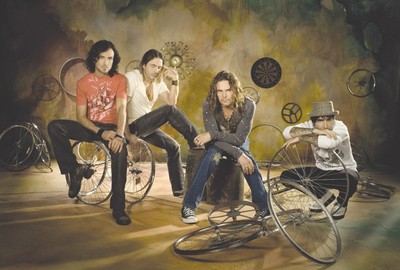
If one were to look at the top music charts rather than specialty genre listings, it would truly seem that the recent ‘rock en Espaãol’ movement was little more than a fad. However, nothing could be further from the truth.
There exists practically a parallel universe to the traditional and indie rock band, with artists who are almost completely unknown to typical American audiences yet can pack arenas with their faithful fans. Such is the case with Manà .
Even in a music economy that seems to be in a perpetual downward spiral, the Mexican quartet is a major draw, opening their current U.S. tour with a two-night stand at the ipayOne Center Friday and Saturday, Feb. 9 and 10, with the latter already sold out.
The group’s origins go back to 1986, when frontman Fher Olvero and Colombian drummer Alex Gonzalez first joined forces with Ulises Calleros and his brother, bassist Juan Diego Calleros, in the city of Guadalajara, Mexico. Their sound, mixing rock with reggae as well as pop, quickly had major labels in attendance at shows. They soon signed with Polygram, but by the time Manà ‘s debut album, Falta Amor, appeared, it was 1992, and they were recording for Warner Bros.
The band’s line-up changed early on, with Ulises Calleros replaced initially by a keyboardist and additional guitarist. Both only lasted one album, 1994’s “Donde Jugaron los Ninos?,” before the band finally settled on Sergio Vallin in 1995. His first recorded work with the band ended up on that year’s release, “Cuando Los Angeles Lloran.” By this point the band were already superstars throughout Latin America, with small pockets of fans elsewhere. That began to change with 1997’s Sueãos Liquidos. Through relentless touring, and with major label support behind them, the band began to make an impact in Europe and the U.S.
In 1999 Manà ‘s efforts paid off when they made an appearance on MTV’s “Unplugged” show and, more important for their street cred, collaborated with guitar legend Carlos Santana. The timing couldn’t have been better. They dueted with Santana on the track “Corazon Espinado,” which ended up on his multi-platinum comeback album, “Supernatural.” Although Manà had more than paid their dues, this exposure was priceless.
It would be three years between albums for the band, but when their next disc, 2002’s “Revolucion de Amor,” appeared, Santana was on it. The CD sold well, but the highest honor came the following year, when they won a Grammy for Best Latin Rock/Alternative Album. Manà took an even longer time to craft a follow-up, but in 2006 fans were rewarded with “Amar es Combatir.” The band’s fan base by this point was such that the album became the highest charting debut “” No. 4 “” for a Spanish-language album on the Billboard Top 200. There was even an exclusive edition of the album released by Target Stores.
Currently, the band is touring behind their new single “Manda Una Seãal,” but their two San Diego shows will likely showcase the hits, and the fans will respond like a slightly less raucous version of Beatlemania. Making these shows extra special, the night after they leave our town, they will be attending the 49th annual Grammy Awards, where they are nominated in the category Best Latin Rock Alternative or Urban Album.
The jury remains out on whether or not Manà will ever fully cross over to the mainstream rock crowd. The language barrier is one factor. But as two packed ipayOne shows will reflect, their fan base is exploding. Not many groups could fill the venue one night, let alone two.


