


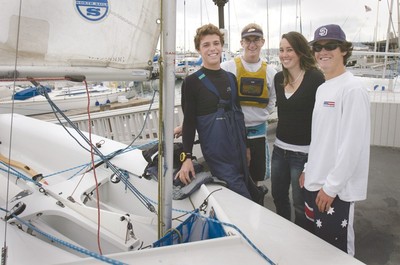
In the past seven years, the Point Loma High School sailing team has finished fourth or better in the national rankings, winning three championships in a row from 2003 to 2005.
This season is no different, as the team has taken home two wins within the past month.
On Jan. 6 and 7, the sailors beat out 57 high school teams to run off with the trophy at the Rose Bowl Regatta in Long Beach. The event was the largest combined college and high school regatta in the U.S. and was organized by the US Sailing Center of Long Beach and Alamitos Yacht Club, with over 400 sailors in the Club Flying Junior boats.
Last December, teammates Tyler Sinks and Morgane Renoir won the Orange Bowl Regatta on Biscayne Bay in Florida. The event, which ran from Dec. 27 to 30, attracted between 600 and 700 sailors from across the United States and other countries.
“Sailing in Miami attracts all the people from the Northeast and Midwest who pack up their whole families and bring their boats down,” said Sinks, who has attended the event for the past five years. “The warm winter weather makes it one of the most competitive in the United States every year.”
Sinks, a senior, and Renoir, a junior, bested 80 other teams split into four flights, tying on the first day of the four-day event and eventually working their way up to the top spot by the end. The Orange Bowl is one of the few high school regattas to utilize the spinnakers and trapeze that make the Club 420 boats faster and more complicated.
“We’re a younger team, but we do have the people and skill to do real well this season,” said senior Ben Todter. “We have a lot of freshman, so we have to work a little harder. The seniors have more experience, going to nationals three years in a row “” most of our upperclassmen are top in the country.”
The team, led by coach Steve Hunt, stresses that the high school regattas are a small part of their careers, with four of the seniors competing internationally this past year in Spain, England and France. The main reason the Point Loma team had been so dominant, according to the team, is the weather. The sailors in San Diego can be out on the water every week, all year long, perfecting the small things that can really add up during a race.
“We have more ’tiller time’ because we can sail year-round “” that gives us an edge,” said senior Briana Provancha. “This team is a big commitment “” ideally [we practice] at least twice a week from 2 p.m. to 6 p.m. “” which can be hard with homework and tough financially.”
East Coast schools have traditionally dominated high school sailing, but the PLHS team and a few other Southern California teams have been trying to change that. The best universities for sailing have also been on the other side of the country: Boston College, Tufts, Georgetown, Harvard, Hobart, Dartmouth and the Naval Academy in Annapolis. But West Coast schools such as Stanford are gaining ground with kids who want to avoid the cruel winters.
“When it’s warm, you don’t really worry about how cold you are and the dry suit (needed in cold water) is harder to move around in,” said Todter. “You have to try much harder to concentrate when you are in colder weather, and the most we wear here is light gear.”
One difference between Point Loma and other teams could be the coaching staff’s attitude toward training. Many people associate the skippers “” the ones who ‘drive’ the boat from the stern with a vigilant hand on the tiller “” as the most important member of the team. But the crew “” the second part of a two-person team “” is responsible for many events and can make a huge difference in the outcome of a race.
“You might as well use both brains. You can go faster when you work as a team, making automatic adjustments seem like second nature,” Provancha said. “You end up thinking the same thoughts “” you know how to read what the other person is going to do in a particular situation.”
The team is looking forward to improving throughout the season, which culminates with the nationals in Long Beach May 12 to 13.


