


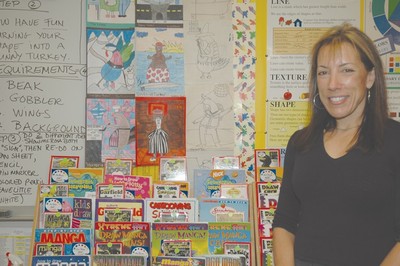
?In a culture in which school arts programs are the first to be nixed due to budget concerns, Correia Middle School art teacher Lilly Rosa’s vibrant classroom is a creative oasis among a sea of dried up curriculums.
Now in her second year at Correia, Rosa, who is responsible for nourishing the imaginations of hundreds of students, touts the immeasurable rewards that the arts offer.
“It keeps kids motivated,” she explained. “It gives kids an outlet to be able to talk without words. There’s so much struggle, and if you don’t give them something to hold onto while they’re struggling, they’ll give up.”
A native San Diegan, Rosa graduated from the University of San Diego with a bachelor’s degree in fine arts. It was at the urging of her mentor and former art teacher, Estelle Kassebaum, that Rosa decided to pursue art.
“She’s really the one who put me on that path to consider the arts as a career,” Rosa said. “It shows how teachers can really influence students.”
These days, Rosa keeps a picture of Kassebaum at her workstation in the back of her classroom for inspiration. “She was just the most incredible human being.”
It was during her 11-year tenure at Horace Mann Middle School (now Mann Middle School Complex) that Rosa said she saw first-hand the fundamental importance of teaching arts.
“I really firmly believe there’s a direct correlation between the low performance in schools and the cutting of the arts programs,” she said. Shortly after Rosa left the school, its art program was reduced.
After a 9-year sabbatical, during which time Rosa opened a gallery in Old Town to display her own work, she returned to the school system by accepting an offer at Correia.
Formerly Collier Junior High School, it was renamed after glasswork artist Steven Correia. A few his pieces are displayed in the main office.
Rosa praised Correia officials for their commitment to retaining its arts programs.
“The administration and their support here is just fabulous, and parent involvement is great,” she said. “I’m just so happy to be in a place where I’m appreciated as a professional.”
Rosa said she passes her love for art on to her students in hopes that it inspires them to want to be present.
“It’s really neat to know that somewhere along the line that you inspired children and the decisions they make for the future.”
Rosa said she is conscious not to separate her professional and personal passion for art at the classroom door.
“I’m a real proponent of letting the kids know I’m a practicing artist as well,” she explained. “This way, the kids can see you practice what you preach.”
Currently, Rosa has her classes are working on a seasonal project called Turkey Transformations, in which she offers students a template, a few guidelines and encourages them to draw a turkey in a specific environment.
“I try to do projects with a high success rate,” she explained.
In an effort to promote student talent, Rosa is vigilant about displaying student artwork around the campus.
She also encourages students to point out their work to other teachers and friends. This way, she said, other teachers get to see their students in a different light and perhaps consider how to approach different subjects by employing art.
Kris Spathas is president of the Correia Association, the school’s volunteer fund-raising and parent support group.
“I love the fact that [Rosa] thinks that every student has potential and she tries to bring out the best art in them,” Spathas said.
Currently, art is only offered as an elective class for students, though Spathas mentioned there has been some interest in changing that.
“A lot of parents at our meetings have inquired about developing some sort of program where all students can benefit from Lilly’s art program,” Spathas noted.
And with word of Gov. Arnold Schwarzenegger’s recent promise to allocate more money to school arts programs, Rosa is decidedly optimistic.
“What I’m seeing is, I think, finally, someone’s seeing the light,” she said.
With additional funds, Rosa said she would buy a pottery kiln and turn the classroom into a pottery studio for a portion of the year. She also dreams of upgrading the student gallery space around the campus.
“I’m keeping my fingers crossed,” she said.
But not everything is roses for Rosa; she criticized California’s policy of assigning teachers without a background or degree in the arts to lead art-related classes and programs.
“It’s doing such a disservice for future artists and musicians,” Rosa said. “Anybody can teach anything, but is that what education’s about?”
Rosa also disapproves of “Art in a Cart,” referring to art programs consisting of little more than a mobile cart of supplies that travel from classroom to classroom in place of more established art curriculum.
In the future, Rosa said she hopes the tide will change to recognize the importance of art instruction.
“Whole education should include the arts – not just what’s considered the ‘core classes,’” she said. “I hope to see performing and visual and musical programs at every school.”


