


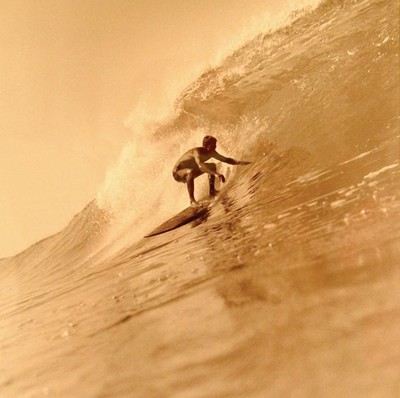
Ponce de Leon spent years sailing the seas searching for the fountain of youth, when all he had to do was jump over the side! So stated Surfer’s Journal publisher Steve Pezman at a Nov. 9 speaking event at the Quint Contemporary Art Gallery, 7739 Fay Ave., which was held in conjunction with the final days of an exhibit of surfing lifestyle photographs by Ron Church. What Pezman meant was that the act of surfing, with its physical and mental stimulation, is enjoyed by sports enthusiasts well into their 80s and perhaps beyond.
“After all,” he said, “We are made up mostly of water!”
The exhibit of Ron Church photographs that just ended after a month-long showing featured classic images of a period of time from 1960-’65, with shots of La Jolla, Hawaii and other locations.
Church was a much-honored and accomplished underwater and marine life photographer who became intrigued by the youthful blossoming of the surf culture in the early 1960s, years before revolutionary changes in surfing equipment cut surfboard lengths by a third and fueled a more carving, radical approach to wave riding. Tragically, Church died of a brain tumor in 1973 when he was only 39, but his classic images survived under the care of his widow, Shirley Richards, of Washington state. In recent years, graphic designer Tom Adler visited her and was amazed at the elegant composition and skillful quality of the work, and helped see that Church’s efforts got displayed and published into stylish art books. For many who grew up in that era, the iconic images tug at some nostalgic feelings.
“Ron Church captured the sport when it was sort of morphing and preserved a unique time in surfing history,” Pezman explained. “He took the first published surf shots at Honolua Bay on Maui, and I recall buying one of his prints he took of me surfing and immediately sending it back to the girl in California I wanted to be my girlfriend!”
Skip Frye, a local San Diego surfing and board-shaping legend, was on hand for the event and offered some reflections of his own.
“I’ve been surfing since 1958 and shaping since 1963, and back then there was just a four-lane road up the coast,” Frye said. “We didn’t even know where the swells came from when we went down to the beach! People call it the ‘golden age of surfing,’ but I think the balsa era (when surfboards were made of balsa wood, before polyurethane foam production dramatically changed the equipment’s manufacturing in the late ’50s) was truly the golden age. Even the boards were a golden color. I wish I had experienced more of that time, but I started surfing relatively late. Still, I’ll be surfing 50 years in 2008 and I still love it!”
Linda Benson, an Encinitas native who first paddled out at age 11 in 1955, also spoke at the Quint Gallery.
“I just fell in love with it, although I was so small I couldn’t carry my own board at Moonlight Beach!” she said.
She quickly progressed, and in 1959 became the youngest competitor to win the prestigious Hawaiian Makaha International Championships in the women’s division. She also became the first female to ride the giant winter waves of Waimea Bay that same year. Her competitive success included winning the U.S. Surfing Championships held annually at Huntington Beach five times, from 1959 through 1968. Nowadays, she teaches women to surf at her own surf school in Encinitas.
“Ron Church captured the essence of surfing, a clean, American thing,” Benson said. “Those were wonderful times.”
For information about the Quint gallery and its new “Heavy Light” digital art show, call (858) 454-3409.


