


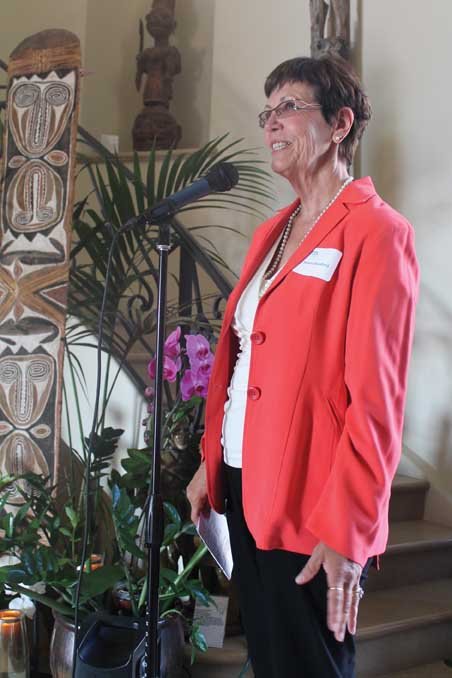
Best known as the pioneer of the securities class-action lawsuit, La Jollan William Lerach held a two-day fundraiser at his seaside estate July 28 and 29 to benefit Proposition 34 — the Savings, Accountability and Full Enforcement for California Act, or SAFE California. If enacted by voters in November, the initiative would end the death penalty in the state, replace it with life in prison without the possibility of parole, set aside $100 million over three and a half years to address unsolved rapes and murders, while forcing inmates to work and pay restitution into the Victims Compensation Fund. The guest list for the invitation-only event included actors Mike Farrell and James Oliver Cromwell, actress and singer Shelly Faberes, former San Quentin warden Jeanne Woodford, Holocaust survivor Edith Eager and Franky Carillo, who at 16 was wrongfully convicted of murder and found innocent after serving 20 years in prison. “I’m morally opposed to the taking of any life, even if it’s the life of a murderer,” said Lerach, who added he is not a member or spokesperson for any organization in support of Prop. 34. “But that’s not the argument in favor of this initiative. It will save huge amounts of money and insure that no person is ever executed again and that’s the least that we can do.” Lerach said the event, which raised more than $200,000, was well attended by La Jollans and that 100 percent of the proceeds were donated to the SAFE California campaign. As a young boy growing up in Pittsburg, Lerach said he was profoundly impacted by the 1954 trial of Dr. Sam Sheppard in Cleveland, Ohio, who was wrongly accused, convicted and sentenced to death for the murder of his pregnant wife. After nearly a decade of incarceration, he was exonerated and freed from prison, but as Lerach said, “His life had already been ruined.” “It caused me to be cognizant that innocent people can be convicted of capital crimes,” he said. “I was more imbued with a strong sense that the system is very imperfect and subject to manipulation by prosecutors and judges, and I came to hold the view that in such a system, you cannot impose the death penalty, because it’s irrevocable.” While the warden at San Quentin State Prison, where all condemned males must be housed and put to death, Jeanne Woodford oversaw four executions. She later served as the undersecretary and director of the California Department of Corrections and Rehabilitation (CDCR). Woodford said there have been 140 death row exonerations in the United States since 1973, and that even in states that purport to have a speedy process, it takes on average more than 15 years before an inmate is executed. Since she started her corrections career in 1978, only 13 people have been put to death. “I feel as if I can talk about this issue as few others can, because I’ve seen it from all points of view and I know how expensive and costly and how broken the death penalty is,” said Woodford, who said her argument is not moral, but about dollars and cents. “In fact, what we have is inmates serving life without the possibility of parole who have a death sentence, but we continue to spend millions of dollars on their incarceration, because of how we house death row inmates and on their appeals and legal issues.” According to a comprehensive analysis of the death penalty’s costs, since it was reinstated in 1978, California has spent more than $4 billion on capital punishment, or about $308 million per execution. Woodford said that with limited criminal justice dollars, it’s a public policy issue and the most appropriate thing to do is spend that money in the most effective way to keep communities safe. “The death penalty robs us of that opportunity each and every day in California,” Woodford said. Opponents of Prop. 34 argue that abolishing the death penalty is unfair to victim’s family members who have lost loved ones, and that a better way to cut costs is to reduce excessive delays caused by endless appeals and carry out the executions of those sentenced to death. Among those opposed to the initiative include the Peace Officers Research Association of California Political Issues Committee, Kern County Prosecutors Association, Sacramento County Deputy Sheriff’s Association and the Riverside County Deputy District Attorneys Association PAC. More information on the SAFE California Act can be found at www.-safecalifornia.org or by calling (415) 525-9000.


