


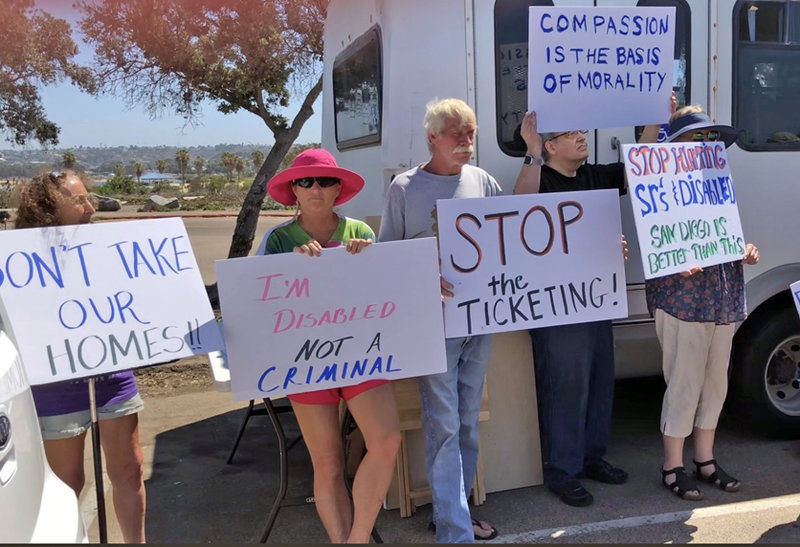
RV residents rallied at Mission Bay July 23 demanding an end to City policy allowing ticketing and impounding of their vehicles.
The rally featured comments from residents who live in their RVs, many disabled, who are receiving tickets under two existing city ordinances: (SD Muni. Code § 86.0139(a)), prohibiting parking an RV anywhere on City streets and lots between 2 a.m. and 6 a.m.; and (SD Muni. Code § 86.0137(f)), prohibiting vehicle habitation. Police may impound their vehicles after five unpaid tickets.
“We want everyone to know, including the police, that we’ve filed suit calling for them to quit ticketing RV owners, many of whom are on disability, and are far more affected than they would otherwise be and have nowhere else to go,” said attorney Ann Menasche, representing RV owners, whom she pointed out are on limited finances and disproportionately impacted by the two existing RV statutes.
“Some of these people are existing on disability, which pays $900 a month, not enough for them to afford a home,” Menasche said. “If their vehicles get towed, or impounded, it could compromise their health — or even worse. In fact, I know of one person who died because of it, a guy whose father was paralyzed.”
Disability Rights California, Fish & Richardson, and the National Law Center on Homelessness and Poverty filed a class-action lawsuit, Bloom et al. vs. City of San Diego, in U.S. District Court in November 2017. The suit challenges the city’s ticketing and impoundment policies on grounds that they are unconstitutional and discriminate against people with disabilities under the Americans with Disabilities Act.
A motion for preliminary injunction requesting a stop to the ticketing and impounding of vehicles while the lawsuit is pending was scheduled to be heard July 26 before Judge Anthony Battaglia.
“The City cannot comment on pending litigation,” said Katie Keach, director of Communications Department for City of San Diego.
RV rally speakers said those targeted were often hard-working people who paid taxes all their lives before becoming disabled or falling on hard times.
Valerie Grischy, one of the suit’s plaintiffs, was a licensed chiropractor with a successful career before getting into a serious car accident in 2009. Her only income now is Supplemental Security Income.
“When I saw that I got less than $900 a month on disability, I knew that I could either pay rent or pay for other necessities I need to live, but not both,” Grischy said. “The only option that made any sense was to use my back SSI money to get a RV.”
Prior to the rally, Grischy said, although she’s not a traditional homeowner, that RV living has allowed her to maintain her independence.
“My RV has allowed me to have my autonomy and my own space, my own place to live,” she said. “I’m not crammed in with a lot of other people.”
Grischy, who has a large dog and a cat living with her, said she and other RV denizens are forced to constantly relocate and always live in fear of getting tickets they can’t afford.
Concerning what she’d like the city to do, Grischy replied, “There are plenty of parking lots that aren’t surrounded by residences that are mostly vacant in the evening. Why can’t RVs be in parking lots, like South Shores, Fiesta Island or Mariner’s Point at night?”
Fines RV owners are subjected to range from $50 for violation of signs while parking at odd hours to $112.50 for vehicle habitation. The cost of reclaiming a towed vehicle is substantially higher.
States the RV class-action lawsuit: “In the midst of a severe housing crisis, dramatically rising rents, a shrinking affordable housing supply, scarcity of shelter beds and a homeless population that has grown 23 percent in five years, the City is targeting its most vulnerable residents. There are at least 817 unsheltered homeless residents in San Diego, many with disabilities, who seek shelter in their RVs, campers.
“Their vehicles are their only reliable, safe shelter from the elements and only place to store their belongings. Yet, even though there are no adequate alternatives, the City has repeatedly ticketed and harassed these individuals for seeking shelter in their vehicles, or simply for owning vehicles and having nowhere else to park.”
Menasche, senior attorney with DRC who is among attorneys representing plaintiffs in Bloom et al. vs. City of San Diego, concluded: “It makes no sense from a public health perspective to take people’s RVs and throw them onto the streets. Rather than solve the city’s homelessness crisis, it places people’s health and very lives in jeopardy and makes the situation that much worse.”


