


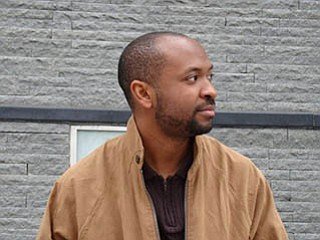
The fact that one can attend a poetry reading on a Saturday night, albeit “right down the street” from their residence, is truly a treasure to behold. DG Wills Books has seen several prominent authors, poets, celebrities and journalists pass through its doors over the years – Norman Mailer, Gore Vidal, Allen Ginsberg, Patricia Neal, Allen Ginsberg and countless others. On Saturday, July 22 at 7 p.m., another world-renowned poet, Gary Jackson, will be reading at the cozy beacon of letters.
Gary Jackson was born in Kansas, and is currently a professor of poetry at the College of Charleston at Charleston, SC. His collected work of poems “Missing You, Metropolis” explores universal elements of racial identity, superheroes, despair, beauty and humor. In order to become better acquainted with the man behind the work, La Jolla Village News interviewed Jackson leading up to Saturday’s reading. LJVN: Did you come to the idea to use superheroes as a universal reference point? As in, your themes can be universally approached, even for those who may or may not have had similar experiences?
Gary Jackson (GJ): Since I grew up on a diet of comic books while living in Kansas, it seemed perfectly natural to use those comics as a means of escape, even though I wasn’t acutely aware of it at the time. Having lived through losing a fair amount of people close to me during those years, I stumbled on the idea of using superheroes and comics as a vehicle for that loss when I began writing poetry. But it’s my hope that people don’t need to be comic fans to enjoy those poems.
LJVN: What cultural differences (either positive or negative) have you seen between Kansas and South Carolina? Both seem to cling to history a bit too tightly…
GJ: Well, being a black man, I always felt hyper-visible growing up in Kansas, and—maybe more importantly—since Kansas is home, and the place I lost more than I can truly articulate in any poem or interview, it hurts to look at. I can’t go back (unless it’s to visit). I couldn’t live there again. I’ve only lived in South Carolina for four years, so not enough to truly get a sense of its own sense of identity (though I could venture an estimated guess). But although there are spaces in Charleston where I’m also hyper-visible, there are many more spaces where I can be invisible, can be comfortable in a way I never quite could in Kansas.
LJVN: When did you discover poetry as an outlet? Was there anyone in particular that helped you with your start, or just persistence?
GJ: If I’m not counting the poems I wrote when I was in middle school/high school, I really discovered a love for writing poetry during my first/second year in college at Washburn University. Amy Fleury was my poetry professor, and she’s a wonderful poet, and really cultivated my love for language. I also worked on fiction with Thomas Fox Averill, another amazing writer I learned a lot from when I was just a kid fumbling around with words. I owe those two mentors everything. It was Amy who eventually coaxed me into applying for grad school. I remember her telling me “you know, you’re not terrible at this” in regards to writing poetry. I guess she was right! Ha.
LJVN: How does “Missing You, Metropolis” differ from your other work?
GJ: Missing You, Metropolis is all about using superheroes and pop-culture to explore racial isolation, suicide, loss, and simply growing up, and although there are many, many poems that don’t use superheroes at all in the collection, it’s the persona poems in the voices of superheroes that seem to be the stars of the show. These days I don’t play with superheroes that much (though I still explore that world, because it is an obsession—and I can’t help myself). I’m currently writing poems about family and diaspora and being biracial: my mother is half black and Korean, and I lived in Anyang, South Korea for a little over a year, so I’ve been exploring those collisions of culture for awhile now. But see, I just lied to myself! I’m also working on these visual hybrid poems that combine illustrations and poetry.
I’m working with this visual artist and the idea we had was to create our own little world of superheroes and maybe create a graphic novel/poetry collection book? It’s all still a work-in-progress and is very fucking exciting and a little intimidating since it’s so different from anything else I’ve done. LJVN: Although poetry will always remain an important medium, is there any particular direction you see modern poetry going?
GJ: As soon as I try to predict something as large as poetry, I’ll inevitably put my foot in my mouth. But the opportunities that writing/reading poetry brings to us never ceases to amaze me—Saturday night’s reading at DG Wills Books being one example, this interview being another, but also all the myriad ways poetry can connect us to each other. At its core, I think all literature is an attempt to convey something (anything!) of experience to someone else. All I can say is that I’ll be along for the ride as long as I can be.
LJVN: Thank you so much for your time. We look forward to the reading on Saturday.
GJ: Thanks for talking with me. I hope I did these questions justice.


