


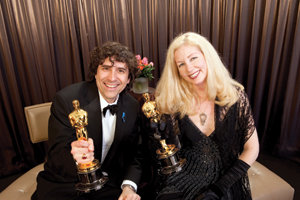
Christina “Chris” Innis and husband Bob Murawski laid claim to an Oscar for best editing on the best picture hit film “The Hurt Locker,” as directed by best director Kathryn Bigelow. What makes this unusual? Innis attended Point Loma High School as a student in teacher Larry Zeiger’s theater-arts program. She moved on to Hollywood after attending University of California, Berkeley and CalArts. Innis snared the honor during the March 7 Academy Awards gala and recently made time to answer some Hollywood-oriented questions for The Peninsula Beacon. Does winning an Oscar for “The Hurt Locker” now give you carte blanche in selecting your next films? Innis: “I don’t know how it is going to change my life and my career yet. What I do know is that an Oscar is the highest honor that a person can receive in filmmaking, and I hope to live up to that. The best thing about it is that I know that we, that is my husband and co-editor Bob Murawski and I, did some of our best work on a film that will hopefully stand the test of time and be remembered for decades to come. It’s a dream come true and the best ending for a difficult independent film that might not have ever seen the light of day.” You and your husband are “breakout” editors and two of the few who have become famous. How do you look at fame, what does it mean to you and do you feel it will help your careers? Innis: “Most people watch movies and are totally unaware that film editors even exist. It’s the movie stars most people want to meet. So the best thing about winning the Oscar for film editing is not any momentary ‘fame’ that we might achieve, it’s the knowledge that we did some of our best work on a film that will be remembered and which is now a part of film history. We are avid film enthusiasts and moviegoers too, so that means a lot to us. Hopefully, all of these awards are an indication that ‘The Hurt Locker’ won’t soon be forgotten. With any luck, those who haven’t seen it, but who have heard about it or it’s Oscar wins will seek it out. It’s the best possible outcome for the film and for us. It was a brief chance for editors to be treated like royalty, and we were. It has been an amazing journey on this film, from start to finish, and one that we won’t soon forget.” How much influence does editing have on the success or failure of a film? Innes: “Editing has a tremendous influence on the success of a film. That’s why film enthusiasts and Oscar historians have long noted that there is a direct link between the Academy Award for best picture and best editing. I think that is because film editing is the craft that defines and is unique to cinema. We are linking images, story points, character arcs, ideas, thoughts, words, music, text, movement, acting, photography, music, visual effects all in one craft in which the infinite possibilities of juxtaposition determine a film’s outcome. Editing alone can’t make a film a success, but it can bring a film to life and it can help focus and sharpen the story, the action and the characters.” Film editing has always, more or less, been a man’s game. Does being an award-winning editor now open up the field to more women? Innes: “From what I gather, women have traditionally done pretty well as film editors, and I’m certainly nowhere near the first woman to receive an Oscar for film editing. The numbers of women directors are far fewer, though. Then again, it wasn’t our goal while making the film for it to be a historic “women’s film.” We were just trying to make the best possible film. Even so, I wouldn’t mind if the award wins on ‘The Hurt Locker’ opened up the eyes of agents, producers and studio heads to seeing the potential of women filmmakers.” Does being a role model for women suit you, or would you rather shy away from being a hero to young girls/women who are thinking about becoming editors? Innes: “I don’t think ‘The Hurt Locker’ is a traditional ‘chick flick.’ So if we changed that definition and the characterization of what kinds of films women can and should make, then cool! The more often we women filmmakers can surprise ‘the suits’ with our results, the more often we won’t be second-guessed as artists. Eventually, women making films won’t be seen as an anomaly. If the success of our film inspires other women to stick with a career path in filmmaking, rather than giving up after they leave film school, then that’s all the better, too. We do need more films made by women. The studios need to hire more women filmmakers. Too few major films are helmed by women, and there are too few female department heads.” You took theater arts classes from Larry Zeiger, a man who is very proud of you. Innes: “It’s nice to have the support of my former teachers, such as Larry Zeiger, who e-mailed to congratulate me right after the Oscar win. I remember his class as the first place I saw Orson Welles’ great film ‘Citizen Kane.’” You attended Point Loma High and are a “hometown girl.” Any fond memories of going to school in San Diego? Innes: “San Diego will always be my home town. A cruise along Sunset Cliffs harkens back to my high school days lazing around the beach and hanging out with friends. Zip by the flagpole at Point Loma High and you will find the spot where my friends and I all hung out and ate lunch each day – every creative misfit in that school was there. San Diego holds a lot of good memories for me and I still have a lot of friends and family here. It will always be home.”


