


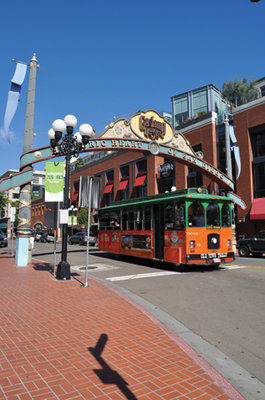
The American Planning Association (APA), a nonprofit community development organization, put an official title on something many San Diegans already knew — that Fifth Avenue is one of America’s greatest streets. Fifth Avenue was designated by APA’s Great Places in America program as one of the “Top 10 Great Streets for 2010” due to the historic district’s successful revitalization efforts. APA’s Great Places in America program, established in 2007, named 10 neighborhoods, 10 public spaces and 10 streets as this year’s Great Places in America. Fifth Avenue was chosen from 180 streets nationwide for its historic heritage, revitalization, pedestrian orientation and vibrancy. The nine blocks of Fifth Avenue between Broadway Street and Harbor Drive that earned this great distinction have not always been an enticing beacon for business and tourism. Only a decade after Alonzo Horton built a wharf at the base of the street in 1969, the gold rush transformed Fifth Avenue into a hub for prostitution, gambling and alcohol consumption. Through city efforts beginning in the 1970s, Fifth Avenue was transformed from a seedy red-light district to what San Diegans see today — a street that has embraced its rich history. “Fifth Avenue has a lot of historic buildings, and San Diego did a lot to preserve those buildings,” said APA’s Senior Outreach Associate Rich Lukas. “San Diego kept that character intact and has not compromised it by properties that don’t respect the historic architecture,” he said. The street that could have been home to imposing skyscrapers is instead filled with an array of architecture from Victorian to Italian Renaissance to Spanish Revival styles. Although the street offers a variety of contemporary and modern buildings as well, Fifth Avenue does not exude a sense of haphazardness. In fact, since the 1970s, the city adopted guidelines that established stringent design and height restrictions to ensure that the historic character of Fifth Avenue remain intact. By 1980, more than 100 historical buildings lined the street, and the Gaslamp Historic District was added to the National Register of Historic Places. In 2002, four gas-operated lamps were installed at the intersection of Fifth Avenue and Market Street to reflect the history of the district’s name. Today, Fifth Avenue is one of the most vibrant streets in San Diego. It is home to festivals including ShamROCK, the Mardi Gras Parade and the Fifth Avenue Auto Showcase, and has attracted more than $7.5 billion in public and private investments. Beyond the large archway sign labeled “Historic Heart of San Diego,” the pedestrian-friendly street is constantly alight with lively Latin jazz music, conversations emanating from restaurant porches and local artwork showcased in windows and painted on utility boxes. “The walkability, vibrancy, pedestrian friendliness, activity day and night, and dining on the sidewalks creates life on the street,” said Denny Johnson, APA’s public affairs coordinator. In addition to the street’s liveliness, Johnson cited other characteristics such as affordable housing and accessibility of transportation as factors in APA’s selection of Fifth Avenue as one of the “Top 10 Great Streets for 2010.” With the help of city officials, private investors and San Diego citizens, Fifth Avenue has transformed from a red-light district to a lively street filled with music, art, dining, shopping, and entertainment. The life that Fifth Avenue brings to the Gaslamp District and the preservation of its historic character makes Fifth Avenue deserving of its new title. For more information about APA’s Great Places in America program or for a list of APA’s winners, visit www.planning.org/greatplaces.


