


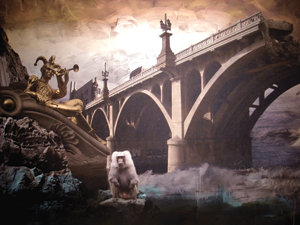
The University Art Gallery at the University of California, San Diego (UCSD) opened its 2010-11 season with a wild and wacky art exhibition by Austrian-born artist Hans Weigand. The show, called “Deep Water Horizons,” consists of an exhibition of eight large 5-foot-by-10-foot, layered multi-media painting collages, which are hung from the ceiling inward-facing in an octagonal pattern in the center of the main gallery space; and a back gallery computer-driven video presentation which you may interact with. In the main gallery, patrons must walk between the hanging canvases and then do an about-face to view an almost circular panorama of odd and unusual paintings that are meant to fit together. The theme of the panorama is a mythological California coastal doomsday, along the lines of the “Planet of the Apes” movie series, in which the earth is destroyed and the only things left are wrecked bridges, broken oil rigs, Greek temples, apes, baboons, surfers (who do not mind because there is still surf) and RV users. The video exhibition in the back room, called “Private View, 2005,” consists of a large-format video projection of another panorama in the form of a personalized narrative of the places and people who have been important in Weigand’s life. Patrons use a computer mouse on a table in the room to scroll from the mountains down to the city, through and around buildings, and over people. At certain points on the panorama it is possible to click the mouse — and a window opens up to play a short related video. When the window opens, German heavy metal or punk rock music begins to play on a set of headphones you may elect to wear. There are actually four different interactive video projections, which are rotated throughout the day. Weigand, who was born in Tyrol, Austria, and educated at the Academy of Applied Art in Vienna, is a product of the pop, trash, sci-fi, and psychedelic movements. He is considered to be one of Austria’s most dazzling, multi-faceted, interactive and well-known artists. Weigand likes to weave “… many thematic threads together … using the montage technique … to tread a path of confrontation … using a good deal of black humor.” Weigand said there are three basic steps in the construction of his paintings for this exhibit. First, he constructed a backdrop of night and day abstract images and atmospheres. Then he layered in a large scale computer-generated montage of photographs, primarily of the California seascape, to which he added a layer of bizarre architectural and environmental details which are like the flotsam and jetsam of an enormous data tsunami. Finally, he hand-painted on a layer of dark smears and smudges which he says is a form of “revenge.” Taken together, he sought to create a “maelstrom of overwhelm and a flood of digital data,” which is meant to be a critique of popular culture. The University Arts Gallery is a small gallery that puts on three or four main shows a year, plus the UCSD MFA Exhibition. In conjunction with the shows, there are usually speakers and films. Usually the artists are people you would not normally get a chance to see in this area. Due to the economic crisis, the university plans to cut funding to the University Art Gallery next year. In order to stay open, the gallery is looking for alternative sources of support and trying to solidify a donor base. If you would like to help, call the gallery director at (858) 534-0419. For further information about the gallery, see uag.ucsd.edu or call (858) 534-2107.


