


A crash course in architectural criticism
By Eric Domeier
There are really just two things you need to know to be an architectural critic: Art is a metaphor. And architecture is an art (not to be confused with a building, which is just four walls and a roof).
A metaphor is an idea that is assigned to an inanimate object. Anthropologists say that Homo sapiens have an innate ability to assign meaning to inanimate objects. And that this is one of the defining qualities of Homo sapiens, separating them from all other hominids, past or present.
And so we project ideas onto objects. Any religious artifact or corporate logo represents more in an image than can be written on a page. But show the same image to my friend’s dog and they will not blink an eye. Unless it’s slathered in peanut butter, of course. Our anthropologist nods and says, “The same goes for Neanderthal.”

To sum it up: Homo sapiens are poets by nature; and architecture is the result of a deliberate intention to put poetry into a building. Once accepting this premise, we embark on an architectural critique of Modernism.
On Modernism
Oddly, Modernism finds its roots in the Ancient World. Back then, Mother Nature was a terrifying power. Weather was unpredictable, natural catastrophes were misunderstood, and humans were not necessarily at the top of the food chain. So it follows that the centers of civilization were defined by straight-line urban development. Expressed in plinths, columns, streets and roofs, the natural world was ordered. To them, a colonnade was an orderly forest. Planned cities, public forums, and sophisticated architecture were symbols of a culture’s domination over nature’s chaos.
Fast forward 1,800 years. The fight between Homo sapiens and the natural environment continues. Having survived the Dark Ages, humans are crawling forward. Then the age of science gives birth to the Industrial Revolution and we unknowingly conquer the natural world.
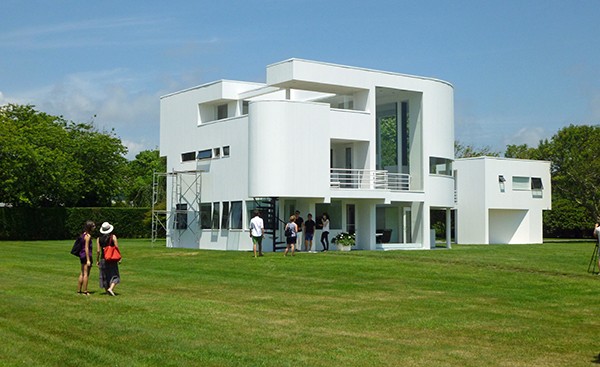
Shortly after this monumental development, the German art school Bauhaus invented Modernism. Bauhaus led the way in revolutionizing the building arts. The premise of the Modernists was the same as the Classicists — to dominate nature. And with a steel mill at hand, they attempted to strike ornamental design from relevance.
This modernist school of architecture introduced industrial production of high-design and created an orderly new world through urban planning. They said things like, “A curved street is a donkey track; a straight street, a road for men” and “A house is a machine for living.”
But the metaphor, machine for living, has a dark side. If the house is a machine, are occupants then robots? Equipment operators? Are we items to be managed and stored by this machine? If this is where that metaphor goes, this is an extremely desensitizing, dehumanizing result. And this is where that metaphor goes.
Cultural desensitization to the planetary impacts of industrialization has resulted in the Anthropocene Epoch — we have irreversibly influenced the planet’s course of evolution and environmental progression. Our invention of the machine made this possible. Our delusion that we, too, are machines desensitized us to the impact of the machine-age and let it spin out of our control.
Heightened sensitivity is the solution. Organic, free-range, and carbon-footprint consciousness are borne from increased awareness to the global consequences of individual decisions.
Developing an organic style
We seem to have lost touch with the fact that we are actually humans — one species in a kingdom of animals. Brene Brown, the Queen of Vulnerability, recently brought a gem to the public sphere. We are not thinking machines that feel; we are feeling machines that think, she states. While we are not machines at all, it illuminates the growing consensus that reason and logic may not be at the core of humanity. Instead, we are organic, fluid, and dynamic creatures prone to intense creativity and far-out thinking. And with training, practice, and tireless discipline we may also be consistently rational, logical individuals.
“Interesting, but what does this have to with architecture?!” our anthropologist asks. Easy, man. We are getting to the point now.
We need to heighten our sensitivity. We mirror our environment, and our environment mirrors us. If we live in a world that looks like a machine, and if we delude ourselves into thinking that we are part of that machine, it is very difficult to stay connected to our natural selves. But if we see the crop that we will eat, the chicken that we will butcher, we will remember where we come from. And if our buildings look like they are an extension of the earth rather than having landed on it, we may be less likely to think we own her.
Organicism is coming to fruition in our built environment. Sometimes we see a random pattern on the face of a Modern building. That’s our old man trying on a new jacket. But a committed organic-styled building is now on the minds of the best designer’s in the profession. We can see this locally in Mr. Quigley’s work, most notably in the new downtown library.
And what of the old man? He still has his purpose. Where a building’s use is for rational and logical operations, he wins the day. Courthouses, universities and hi-tech industry are the domain of Modernism. But for the other public spheres like the marketplace and coliseum, or in the home, a more natural shape will help us remember our place on this marble. And that we now have a paramount duty to take care of it.
—Eric Domeier lives in North Park and practices architecture from his Grim Avenue office. Visit his website at dome-arch.com or call him at 619-531-0010.


