


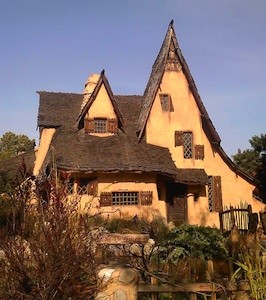
In the 1920s everyone went to the movies, some brought a bit of tinsel town home
Housecalls | Michael Good
When the “Lord of the Rings” trilogy was released almost 12 years ago, the filmmakers braced themselves. They knew Tolkien fans could go a little crazy. They just weren’t expecting them to go crazy over the sets.

Since the earliest days of Hollywood, sets have been illusions: flimsy façades made of plywood, paint, chicken wire, plaster and canvas. They were designed to fool the camera, then fall apart. So when film fans showed up at the New Zealand sheep ranch where Hobbiton had been constructed, they found a moldy façade instead of Middle Earth.
Fast-forward 10 years, to pre-production for “The Hobbit.” The filmmakers and the sheep rancher were prepared. This time, Hobbiton was designed as a working set and a permanent tourist attraction.
This interplay between architectural reality and fantasy has been going on since the earliest days of Hollywood, when homebuilders began looking to the movies for inspiration. The collaboration went further than that: set designers became architects, movie producers became real estate developers, and studio carpenters and painters got jobs building real houses using their make-believe skills. Hollywood became both a real and imaginary place.
And Americans loved it. In 1920, 38 million people attended the movies weekly. By 1930, it was 90 million per week, or 73 percent of the U.S. population.
If there was a man behind the curtain for this whole wacky fusion of fact and fantasy, it was a Hollywood set designer named Harry Oliver. Oliver was a writer, art director and raconteur who spent the 1920s designing sets for films starring Douglas Fairbanks, Mary Pickford and Janet Gaynor.
Oliver had a San Diego connection as well. He designed and built an adobe house for himself in Borrego Springs in the early 1930s. And for the World’s Fair in 1935, he designed Gold Gulch, a movie set without a movie. Among the many visitors to the popular attraction was the Knott family, who in 1940 built their own version of a Western gold mining town in Buena Park.
But Oliver is most famous today for two buildings he designed near Hollywood: the Spadena House and the Tam O’Shanter Inn. The Spadena house was built first on the Willat Studio lot in 1921 and moved, in 1934, to Beverly Hills. The Tam O’Shanter Inn was built in 1922 as a restaurant. It resembled a film set, both inside and out. Oliver had been influenced by German expressionists, and both these buildings are off-kilter, obviously fake and moody, but the mood is more playful than foreboding.
Walt Disney loved the Tam – it was close enough to his first studio that it became his unofficial commissary – and he had his own table there. It takes no large leap of the imagination to see how the building influenced Disney’s designs for fairy tale cottages in his films.
By the mid-20s Hollywood and surrounding neighborhoods were dotted with little Oliver-inspired storybook houses. The trend spread throughout the Southland, where romantic revival houses in the Spanish, English and Colonial style had already begun displacing the serious, honest and forthright Craftsman bungalow. Many 1920s houses were filled with whimsical touches like faux-painted woodwork, dramatic sponge-painted walls, distressed wood shutters, and fake stonewalls, turrets and towers. Some houses played with scale, like the forced perspective of a Hollywood set (or Cinderella’s castle). Instead of walking directly into the living room, as with a Craftsman bungalow, houses unfolded through narrow arched portals and small twisting staircases. It was escapist architecture.
In San Diego, Hollywood found a home in Talmadge Park, a development named for the three Talmadge sisters: Norma, Constance and Natalie. They were among the biggest stars of their day but, just as in Hollywood, the stars were not the true driving force behind Talmadge Park. Natalie was married to Buster Keaton, who was an investor. Norma was married to Joseph M. Schenck, who was the head of United Artists Corporation and also an investor. Other investors included Sid Grauman, of the famous Chinese theater; Louis B. Mayer, vice president of MGM; and Roscoe “Fatty” Arbuckle, the huge (in every sense of the word) star, who, coincidentally, was also a regular at the Tam O’Shanter.
The first phase of Talmadge Park began in 1925 at the intersection of Adams Avenue and Talmadge Drive. All the houses were in the revival style. The real estate office for the development (called The Wonder House of Stone) is still there. Like a Storybook house, it’s deceptive. It appears big, but isn’t. The house is pushed to the back of the lot, making it appear part of a grand estate, which it also isn’t. And it’s not really made of stone.
The Depression put an end to the storybook style, and to many of the revival styles of the 1920s. Although they had good reason, Americans didn’t want to escape anymore. They even stopped going to the movies. Weekly attendance began to drop in 1930 and never fully recovered. Today only nine percent of the U.S. population goes to the movies weekly.
Is every 1920s house storybook? Not in the sense of the Spadena House. But a revival house, by its very nature, is pretending to be something it’s not. Not that it was made to deceive.
The typical 1920s homeowner knew their house wasn’t actually a little castle. They weren’t fooled by the plaster walls that had been scored and faux painted to resemble stone. They didn’t think Rapunzel lived in the tower over the entry. They knew the beams hadn’t really been carved by some gap-toothed village idiot with an axe. They knew all of this, and the fact that they knew it demonstrated their sophistication.
Restoring a fairy-tale house is a lot harder than restoring an arts and crafts bungalow. There’s less information about romantic revivals, less color photography showing what the paint treatments, stain colors, faux painting and other detailing looked like. The restored Balboa Theatre, built in 1926, gives an idea of the paint treatments of the era. Or you can check out the Norma Talmadge Estate in Los Angeles on the web. It’s truly an eye opener.
—Michael Good is a contractor and freelance writer. His business, Craftsman Wood Refinishing, restores architectural millwork in historic houses in San Diego. He is a fourth-generation San Diegan and lives in North Park. You can reach him at [email protected].


