


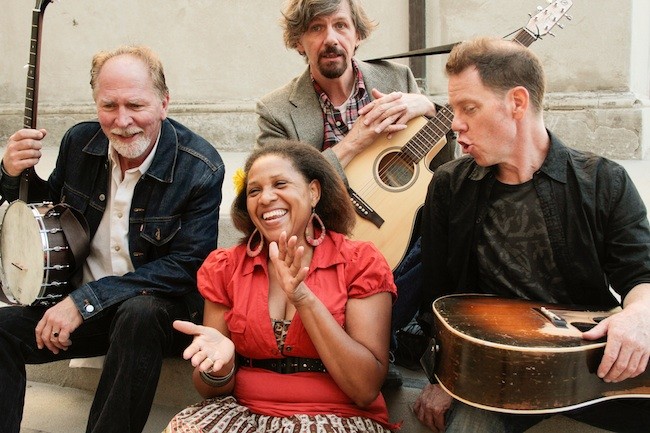
“A Hammer, A Bell and A Song to Sing”
WHERE: San Diego Repertory Theatre, 79 Horton Plaza (Downtown)
WHEN: Thurs. – Sat. 8 p.m., Sun. 2 & 7 p.m., and Wed. 7 p.m., through Dec. 2
INFO: 619-544-0097
WEB: sdrep.org
SD REP resurrects protest musical in timely, poignant production
By Charlene Baldridge | SDUN Theater Critic

Last season San Diego Repertory Theatre and Associate Artistic Director Todd Salovey endured a catastrophe, and as a result cooked up a small miracle.
The REP’s original intent was to produce a world-premiere musical based on the life and work of the legendary Pete Seeger, a formidable protest-song writer and performer of the last century. A few days into the rehearsal period, Seeger, now 93, withdrew his permission. Apparently, he decided he didn’t want to see a musical about his life on stage.
In the grand tradition of “the show must go on” and rather than abandon the work entirely, writer and director Salovey with his triune survivors – veteran actor Vaughn Armstrong and guitarists and singers Dave Crossland and Jim Mooney – cobbled together a script combining a bit of history surrounded by protest songs.
The trio performed the mongrel mix, titled it “A Hammer, A Bell and a Song to Sing,” and called it a world-premiere workshop. The intent – and it worked – was to impel audiences to sing along and “protest” in the grand old American way, yet within a safe space. No reviews were allowed.
Just blocks away, a few months earlier, contrasting personnel had been observed, less comfortably and much more grittily, when real protestors – Occupy San Diego – gathered at the Civic Plaza. The protests occupied the mind and sank into the soul of conscience, at least in those who happened to see them.
In one of the most powerful scenes in the enhanced, resurrected and freshly topical “Hammer,” the Occupy movement and its genesis are explicated for those of us who were raised in the era of “government is good; government can do no wrong.” Cast members represent the range of Occupy San Diego participants from passerby to opportunist. Armstrong is particularly brilliant as a rather stoned homeless man, one of the one percent. Throughout the show, Armstrong’s facile assumptions of character and attitude are truly a joy.
The principal storyteller, Armstrong is a classically trained actor, and now it is apparent that during the past year he’s honed his singing and strumming skills to the point where he seems to the manner born. Furthermore, he’s been there historically, serving while other potential draftees fled to Canada. His basic goodness and sincerity shine through every moment of the show. We may protest – we have always done so – but we love our country.
The others – essentially balladeers and excellent twangers and not actors – also seem more skilled and confident than before. The gangly and ingratiating Mooney is effective when being the heavy; and the more compact, downright adorable Crossland is excellent in the more poignant moments.
The most brilliant stroke in the resurrection, however, is the addition of the easy yet powerful Lisa H. Payton, who adds gravitas and credibility. Vocally she is always in control and she strikes resonant chords in consciousness.
The four sing tout ensemble, in solos, and even in precise, impressive a cappella. Among the songs are Seeger’s “Deep in the Big Muddy,” “If I Had a Hammer,” and his story “Abiyoyo.” Among other songs are “Johnny Has Gone for a Soldier,” “The Times They Are a-Changin’,” “This Little Light of Mine,” “Blowin’ in the Wind,” and “We Are Climbing Jacob’s Ladder.”
There is no glitz in “A Hammer, a Bell and a Song to Sing.” Though these characters represent real people and are dressed in real people’s clothes, they are common people, some disenfranchised.
Even when they might be construed as confrontational, they are safe and we are safe, at least safe enough to sing along, and in the dark, occasionally, when light dawns, to quietly say, “Oh.”


