


Where others saw a sagebrush-covered hill, George Marston saw a progressive paradise

House Calls | By Michael Good
In this partisan political season, it’s worth noting there was a time when the word “businessman” was not always preceded by “Republican,” and a politician could advocate helping the poor without being called a Democrat.
One hundred years ago, the progressive movement held sway both across the country as well as locally. On the national stage, its leading proponent was Teddy Roosevelt. In San Diego, it was businessman George Marston.
Progressives believed the scientific method could be applied to everything: economics, education, government and even family life. Progressives supported taxing the rich at a higher rate than the poor. They broke up monopolies and trusts, backed women’s rights and, in 1914, helped create the Federal Reserve System. In fact, they liked systems of all kinds, whether for manufacturing automobiles or houses.
Burlingame – North Park’s “Tract of Character” – was built on this ideal. Marston, too, used a systematic approach with Presidio Hills, his housing tract and neighboring park, employing city planner John Nolen to design the streets and the landscape, which – according to the progressive ideal – would work together.
Although Marston began purchasing land for Presidio Hills in 1907, it wasn’t until the 1920s that he was able to buy out his partners and get his desired architect, William Templeton Johnson, to design the centerpiece of the park: the Junípero Serra Museum. By the time all the pieces were in place, a new architectural style (and indeed a new political mood) had developed.
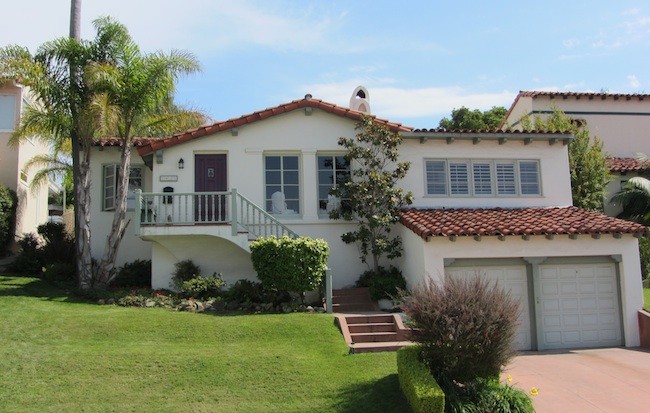
Therefore, the houses in Presidio Hills were predominantly built in the romantic revival style: fanciful recreations of past architectural types, such as Spanish, Monterrey, Mission and English Tudor. By 1925, the humble Arts and Crafts bungalow was passé, as was the progressive movement. A new age of prosperity had arrived.
Despite its progressive roots, Presidio Hills appealed to the roaring 1920s home-buying public.
“These were high-fashion homes at the time,” said Thomas Roetker, Mission Hills Heritage’s events chairman and the organizer of this year’s historic home tour taking place in the Presidio Hills neighborhood Sept. 22.
“The homeowners were civic leaders: bankers and lawyers, businessmen and doctors,” he said, “and the houses were fairly large for the day, 2,500 or so square feet. They met the high expectations of the clientele.”
As it turns out, Roetker had a system of his own for organizing this year’s tour. “First we pick a theme, then keep the tour to a walk-able area, so people can get to know a small neighborhood and how it developed.”
Once he settled on Presidio Hills, Roetker said he began canvassing homeowners to participate in the spring. He talked to more than 50 prospects, and got a commitment for the final house on the tour just last month.
Two of the houses are by the same master builder, Alexander Schreiber. About half a dozen Schreibers have been declared historic, including one included in the tour, his personal house. Schreiber would buy several lots in a neighborhood and “the assumption is that he was living here while building additional homes in the area,” said Sonya Palmer, the home’s current owner.
Besides being one of San Diego’s more prolific builders – in addition to Mission Hills, he built in North and South Park, University Heights, Loma Portal and Encanto – Schreiber was a forward-thinker. He constructed the first house in San Diego completely wired for electrical appliances. If you’ve ever tried to install modern appliances in an old kitchen with knob and tube wiring, you know what an accomplishment that was.
Besides the Schreiber connection, Palmer’s home is interesting for a couple of other reasons. “One thing that is really fascinating [are] the columns. I was told by the previous owner that they had come from one of the Panama-California Exposition buildings in Balboa Park,” Palmer said.
“The other thing of interest may just be neighborhood lore,” she said, “[as] there is a little public transportation bus that goes right by the house. Someone said that the bus driver used to say, when he passed the house, that the livingroom had a lot of sterling silver in the ceiling. There are some ornate columns that rise to the ceiling in the living room. They’re now painted silver.”
Under years of paint there could be silver leaf. Or it could just be an interesting story.
During the day Palmer runs an oncology lab for Regulus Therapeutics. The rest of the time she is mother to a 17-year-old son, who needs to be reminded occasionally to go easy on the millwork. Does she find the idea of opening her home to 350 strangers nerve-wracking?
“Not at all,” she said, laughing. “Or maybe I don’t know what I’m getting into.”
Palmer grew up in Washington D.C., in an historic apartment building that’s now named for one of its more illustrious residents, Republican Senator William Borah of Idaho. Borah, surprisingly, was also a Progressive.
“When I moved to San Diego, I knew I wanted to live in an old home, so I focused on that,” she said. The old Schreiber place suits her so well, she said, she has not changed a thing, with the exception of the backyard patio. Palmer redid it to take advantage of Southern California’s bug-free outdoor lifestyle: something you won’t find on the East Coast, no matter how historic your home.
Palmer said she agreed to be a part of the tour simply because she was asked. “I’m very happy to open it up to the community,” she said, adding that she hopes to inspire other homeowners. “It’s great fun to look at old homes.”
While other homeowners may hang around nervously watching visitors traipse through their abode, Palmer will be out on the tour herself.
She should especially enjoy the other Schreiber house, a fantastic fusion of Art Deco and Spanish Revival on Presidio Drive. The livingroom ceiling is particularly spectacular: no silver leaf, but there are carved, wooden beams with Moorish decoration. Whatever your political persuasion, you’ll find it fascinating.
The 8th annual Mission Hills Historic Home Tour, which includes the Serra Museum, is Sept. 22 from 11 a.m. to 4 p.m. Advance tickets start at $20; day-of tickets start at $25. To purchase tickets and for more information, visit missionhillsheritage.org.


