


A brief history of Bird Park
By Steve Hon | SDUN Contributor

In 1902, Samuel Parsons, president of the American Society of Landscape Architects and the superintendent of Central Park in New York City, accepted a commission to design San Diego’s city park. When taken for a tour of the vast, undeveloped area that had been set aside, Parsons became lyrical about the view from the northeast corner of the park that became the corner of 28th and Upas streets.
Standing there, he compared the view of the Coronado Islands to the “stately pleasure dome of Xana Du decreed by Kubla Khan.” The corner was, for years thereafter, called “Parsons’ Gate.”
Despite Samuel Parsons’s identification of the northeast corner of what would be Balboa Park as having one of the best views in the entire park, that corner would be one of the last areas to be developed. It would be 95 years before Parsons’s vision would become Bird Park.
In 1992, the East Mesa Precise Plan (EMPP) published by the City of San Diego called for a new children’s park on the land south of Upas Street between 28th Street and Pershing Drive. Questions were raised, meetings were called and the traffic study outline in the EMPP was revised to the satisfaction of the city engineers and the residents of Pershing and 28th streets. The Pershing spur was closed in order to prevent fast-moving Pershing Drive traffic from entering Pershing Street at high speed. Additionally, at the five-way intersection of 28th, Pershing and Upas streets – the entrance to the narrow 28th Street – was closed with the same intent. Construction began on Bird Park based upon a designed created by local artist Robin Brailsford.
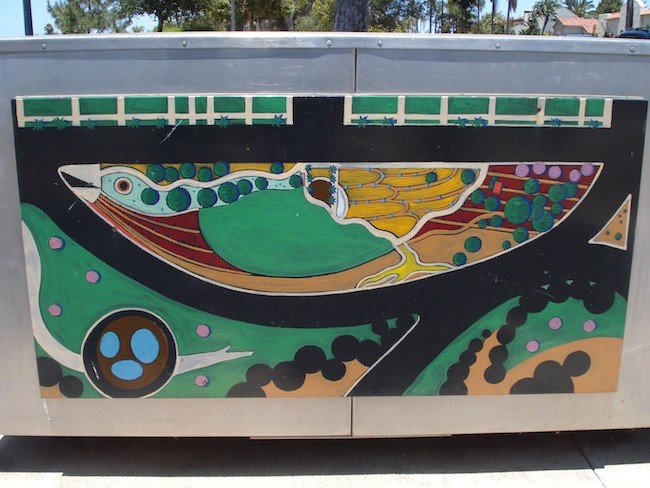
The hardscape of the Park resembles a bird as seen from the air and Brailsford carried the avian theme over to the sidewalks in the park by having the names of many of the species of birds native to San Diego stamped into the sidewalks. Brailsford and Wick Alexander hatched the idea of Bird Park in their home studio in North Park. “Every element to make it look like a bird is there: wing, tail, foot, beak, gizzard and a nest” Brailsford said in an interview with the North Park News in 2002. She began designing the six-acre park in 1994 and found inspiration from the lay of the land.
“Pershing looked just like a branch, and the topography looked like a bird,” she said.
Bird Park opened officially in September 1997. It was immediately popular with the community, as it provided sorely needed additional developed park space and two more children’s play areas. The community also quickly identified that Bird Park was an excellent area to view Fourth of July fireworks displays launched at San Diego Bay.
In 2002, the North Park Community Association (NPCA) began exploring the idea of holding community concerts at Bird Park. Based upon the Friday night concerts held at Trolley Barn Park in University Heights, an NPCA committee that included Beth Swersie, Lorraine Halac, Nellie Harris, Maureen Westfall and Lorrie Moore began work on holding one or two concerts in the Summer of 2002. Harris was the driving force behind the effort.
Ultimately, two concerts were held that summer. The first concert was held on July 12 and featured the Tami Thomas Big Band; the second concert was held on Aug. 30th and the Bill Magee Blues Band performed. The first concert also featured a comedian, Wally Wang, who performed at intermission. By the time Wally Wang took the microphone, the size of the crowd had doubled.
The two concerts in 2002 were incredibly well received by the community and have become a regular staple of the summer scene in North Park.
The final aspect of the development of Bird Park was the completion of the Pershing Portal on the north side of Upas and 28th streets, replacing temporary barriers installed years earlier when 28th Street at Upas Street was closed off. In late 2003, the Pershing Portal Project was completed, forming an attractive pedestrian entry into the heart of this unique historic North Park neighborhood from Pershing Drive and adjacent park areas.
The entry plaza permanently terminated 28th Street, and provided a continuous curb line along Upas Street from west to east. The landscaped plaza is at the same level as the existing sidewalk and contains stamped and colored concrete, including plaques commemorating David Dryden and his wife. Concrete towers 7.5-feet high, with copper roofs, mark the entry, and a quote from the late North Park historian Donald Covington is stamped into the pavement between the entry towers.
This project was years in the making. Mark Weis, City project engineer and North Park resident, said, “I believe the Pershing Portal Project is a realization of the community’s efforts to commemorate the uniqueness and historical significance of North Park.”
A plan to close 28th Street at Upas Street was initiated in 1987 and championed through the years by many North Park residents. Homeowners gathered traffic data in 1992 to substantiate the heavy traffic. In 1993, the City agreed to close 28th Street if homeowners agreed, and in May of that year, a petition circulated among residents convinced the City to create the cul-de-sac. The original conceptual design of the entry portal was conceived in 1995 and ardently supported, but funding was an issue that took more than eight years to solve completely.
—Steve Hon is the president of the North Park Historical Society, which generally meets the third Thursday of each month from 6:30 – 8 p.m. For more information, including meeting locations, visit northparkhistory.org or contact Steve at [email protected].


