


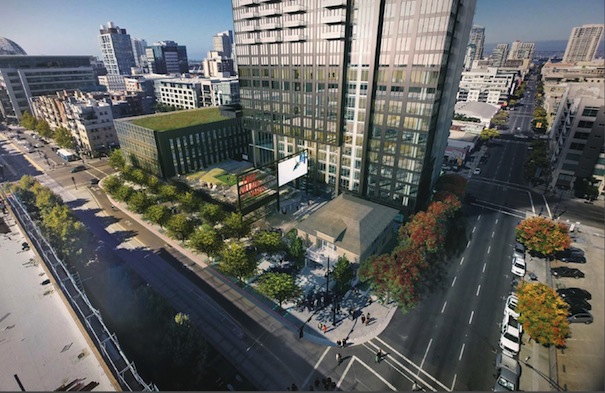
Transportation, business incubation inspire UCSD’s new East Village hub
By Dave Fidlin
Evolving transportation infrastructure and a burgeoning business incubation culture are credited with UC San Diego’s recently announced Innovative Cultural and Education Hub.
In early December, officials within UCSD took the wraps off plans for the 66,000-square-foot development, which will be constructed at the corner of Park Boulevard and Market Street in East Village. The plans were consummated in mid-December, when the City Council approved all of its components.
UCSD’s Extension office will oversee the new Downtown location when it opens, tentatively scheduled in 2020.
Mary Walshok, associate vice chancellor of UCSD’s public programs and dean of the Extension, said the hub site will offer a broad range of programs, similar to those offered at the main campus in La Jolla.
“We’re not talking about just putting in a few departments,” Walshok said about the hub. “This is a site that is going to have a very unique role. This is a game changer.”

There are no plans of stripping away UCSD’s core operations in La Jolla, Walshok said. Instead, the new hub location is designed to meet students’ — and the community’s — changing expectations.
“Cities are sexy again,” Walshok said. “You’ve got young people choosing to be right in the heart of cities, where they can live, work and play. There are a lot of new opportunities for urban growth.”
The shift by the millennial demographic is not unique to San Diego. In other major cities across the U.S., the same trend is occurring, and developmental shifts are following suit to keep pace with the demand.
Alongside the cultural living shift has been new transportation infrastructure — most prominently, San Diego’s expanding trolley line. Walshok said many university officials were opposed to the trolley system when it was first built, though many have since changed their tune.

“We view [the hub] as something that is very critical to San Diego at this point,” she said. “We are a city that grew up around freeways.”
But the growth of the trolley line — incorporating connections to La Jolla, Downtown and North County — has provided more transportation options than ever.
Strategically, the hub is near San Diego’s small, but growing, business startup scene. Walshok said it made sense, strategically, to lay their stakes near the city’s innovation and tech core.
Several prominent city officials, including Mayor Kevin Faulconer, have openly supported UCSD’s new hub and pointed to the reasons they believe it will be a positive for Downtown.
“This new project will continue the revitalization of the East Village neighborhood, and with UC San Diego’s top-notch reputation, provide countless opportunities as we prepare students for the jobs of tomorrow,” Faulconer said in a statement.
By virtue of their design and function, universities are oftentimes associated with higher education. But Chancellor Pradeep Khosla said UCSD also plays an important role in enhancing the local economy.
“This new hub will support economic development Downtown, while delivering new educational opportunities for our students, faculty and staff,” Khosla said in a statement. “[The hub will] provide a greater connection to the communities throughout San Diego.”
In addition to educational classrooms, the new hub will also have a variety of other amenities that are designed to weave into the fabric of East Village and Downtown as a whole. A 3,000-square-foot restaurant on the hub’s ground floor and an outdoor amphitheater are among the separate developments within the complex.
Additionally, the hub is slated to offer arts events and exhibits that will showcase the university and the larger community’s cultural offerings. Workshops and seminars tailored specifically toward Downtown’s workforce are also part of the plans.
The hub will also tie into a bigger picture; a residential development in the location that includes 341 market-rate apartments and 85 rent-restricted affordable apartments for people with low incomes.
According to UCSD officials, no state money will be used to finance the construction of the hub. A variety of funding sources — including program underwriting, contracts and grants, fees for services and lease revenues — will go toward annual operating costs.
Walshok said behind-the-scenes planning took place over a span of five years before the renderings were unveiled last month. With the all-important city approvals granted, Walshok said a target of this summer to begin construction is on track.
“There has been a lot of enthusiasm from the community and it’s something we’re very grateful for,” Walshok said. “We’re all starting to realize this is actually going to become a reality.”
—Dave Fidlin is a freelance journalist with a special affinity for San Diego and its people. Contact him at [email protected].


