


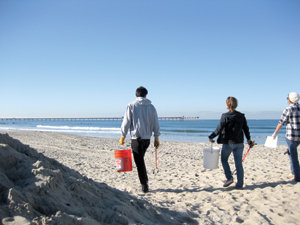
San Diego Coastkeeper and the Surfrider Foundation San Diego Chapter have released data about the state of cleanliness on San Diego’s beaches, and Ocean Beach has struggled to claw its way from the bottom of the trash heap. Compiling data from cleanup campaigns conducted twice a month throughout 2010, the study found that beaches in Ocean Beach continued the trend of previous years as some of the dirtiest beaches in the county. Ocean Beach Pier had the highest weight of trash-per-volunteer in 2010, taking the title from Sunset Cliffs, which had won the dubious honor in both 2007 and 2009, according to the records kept by volunteers at each site. While some areas of the county saw spikes in specific items found — plastic bags dominated in Pacific Beach while balloons found their place in La Jolla — Ocean Beach was “on the higher end of everything,” said Alicia Glassco, Coastkeeper’s education and marine debris manager. Coastkeeper and Surfrider have worked together to collect trash at beaches since 2007. The latest annual report found cigarette butts, Styrofoam and plastics were the most common items found countywide. Glassco said that though the numbers were still high (nearly 6,000 butts were found during one cleanup at Fiesta Island alone — the highest in the county), this is the first time since the city banned smoking on beaches in 2006 that volunteers have seen a level-off in the number of cigarette butts during collection efforts. “We have still seen an increase in cigarette butts on beaches, even since the ban,” Glassco said. “This last report saw a leveling out of butts, so hopefully the idea is catching on.” Ocean Beach came in neck-and-neck with Pacific Beach, though it fared only slightly better than its neighbor to the north. While Tourmaline came in first as having the most trash collected, the stretch of beach at Pacific Beach Drive came in fifth. Ocean Beach Pier and Dog Beach came in second and sixth, respectively. The item of most concern to cleanup coordinators was Styrofoam, because of a sizeable increase in polystyrene waste found over the last few years. Volunteers recorded 25,000 Styrofoam items collected in 2010 — up from 12,000 in 2008. In addition to using the data to educate the public about the items of trash most commonly found on beaches, Coastkeeper and Surfrider use the information to communicate with local politicians and decision makers about important issues. Glassco and colleagues, for example, presented the data from the annual report to the San Diego City Council in January to influence policy on Styrofoam and plastic usage. The trash collected on beaches, Glassco said, comes from numerous sources. Some of it washes up in the surf, some of it is left by visitors and some of it blows from dumpsters in beach communities. “All of it will eventually end up downstream,” she said. “So it’s important to know what it is we’re leaving on our beaches.” Coastkeeper and Surfrider have already announced the full 2011 cleanup schedule, again rotatating locations of popular beaches throughout the county. The cleanups are open to all volunteers. For more information, visit www.sdcoastkeeper.org or www.surfriderSD.org.


